How documents work
Profiles, instant saving and the live preview
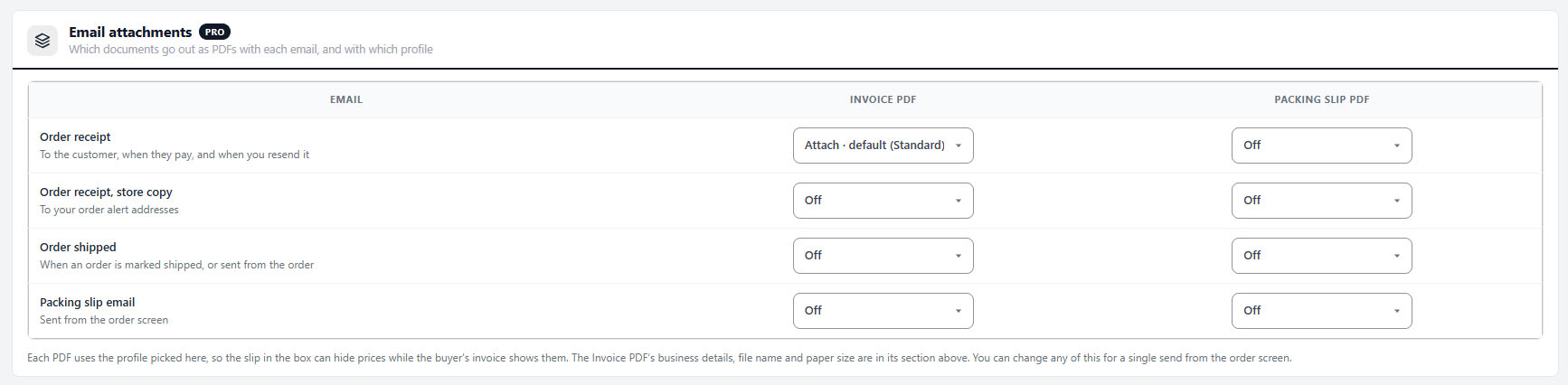
no stored settingsFour documents live here: the order receipt, the shipping confirmation, the packing slip and, with PRO, the invoice PDF. Each one is a set of show and hide switches, and that set is called a profile. Every document starts on its Standard profile, which is the one that goes out unless you choose another.
Switches save the moment you flip them; there is no save button. Beside each editor a live preview shows a real order exactly as it goes out, starting on your newest order. Type another order number to check a tricky one, such as an order with options or a discount. Edit wording changes the headings and phrases a document prints, and Logo & footer gives a profile its own branding.
Upgrading from an earlier version changes nothing on its own: the Standard profiles read the packing slip, receipt and PDF settings you already had.
Packing slip
The page that goes in the box
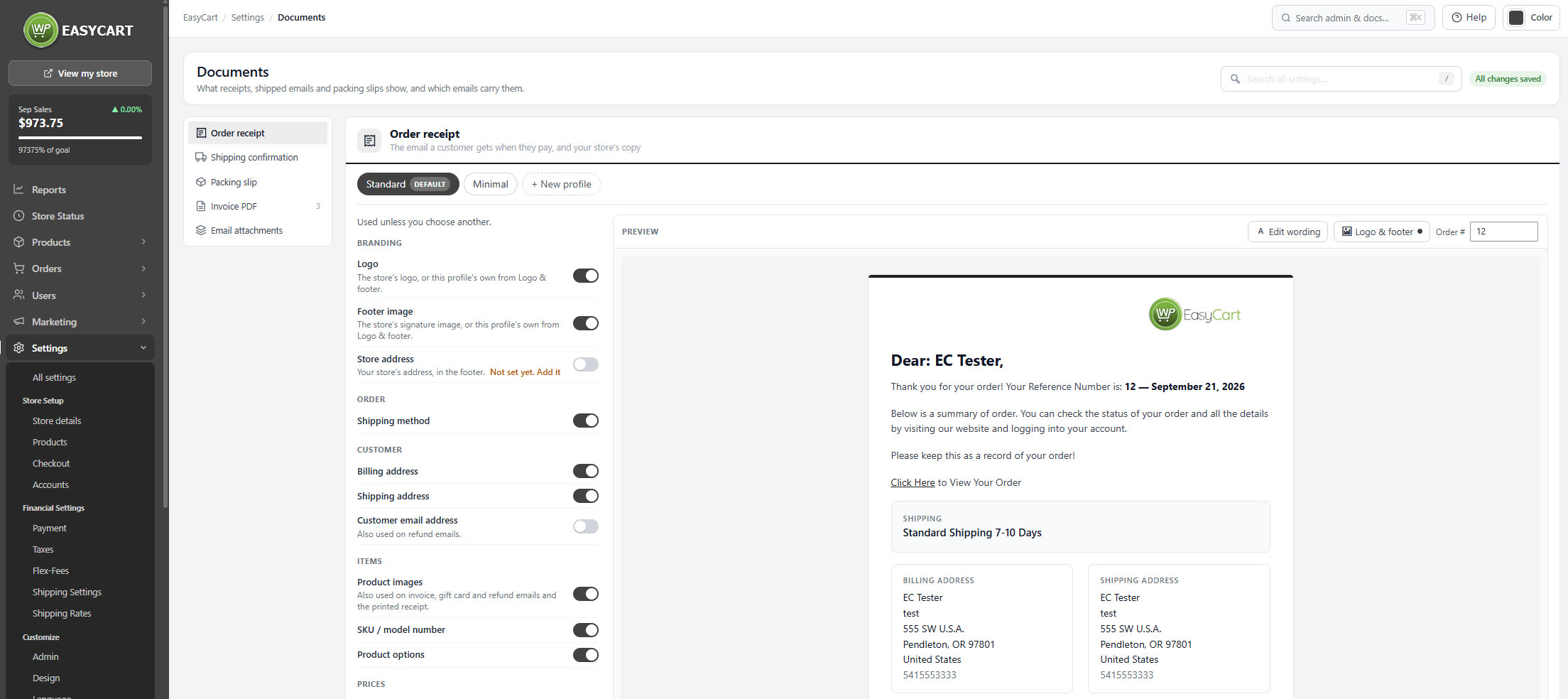
22 settingsLogo
Printed on the packing slip when it is on. The packing slip is a picking and packing document rather than a customer receipt, so include what your team needs to get the right things in the right box, and leave out what only clutters it.
Footer image
The store’s signature image at the foot of the document, or this profile’s own. Handy for a seal, a badge or a scanned signature.
Store address
Your postal address in the footer, entered on Settings › Email › Sender. A return address on the slip saves the customer hunting for one.
Order number
The order number on the packing slip. Keep this on: it is the reference for every conversation about the parcel afterwards.
Order date
Printed on the packing slip when it is on. The packing slip is a picking and packing document rather than a customer receipt, so include what your team needs to get the right things in the right box, and leave out what only clutters it.
Shipping method, carrier and tracking
The shipping method, the carrier and the tracking number, once the order has them. Useful in the box when a parcel is split or re-sent.
Billing address
Printed on the packing slip when it is on. The packing slip is a picking and packing document rather than a customer receipt, so include what your team needs to get the right things in the right box, and leave out what only clutters it.
Shipping address
The shipping address on the packing slip. Keep this on unless your labels are generated entirely elsewhere, because a slip without a destination is a picking list rather than a packing slip.
Phone numbers
The phone number, printed under the billing and shipping addresses. It needs at least one of those turned on to appear at all. Carriers frequently ask for it on delivery problems.
Customer email address
Printed on the packing slip when it is on. The packing slip is a picking and packing document rather than a customer receipt, so include what your team needs to get the right things in the right box, and leave out what only clutters it.
Product images
A thumbnail against each line. Genuinely useful when picking from a catalogue of similar-looking items, and wasted ink when your products are obviously different.
Product titles
Printed on the packing slip when it is on. The packing slip is a picking and packing document rather than a customer receipt, so include what your team needs to get the right things in the right box, and leave out what only clutters it.
SKU / model number
The model number or SKU against each line, which is what a warehouse picks by. If your team works from codes rather than names, this is the most important line on the slip.
Product options
The size, colour or other choices made for each item. Leave this on if you sell anything with variants, because a slip listing the shirt without the size guarantees the wrong one goes out.
Show prices
Unit and line prices on the slip, plus whichever totals you pick below. A slip carrying prices doubles as a receipt, which is convenient for the customer and awkward when the parcel is a gift. Off on new stores; a store upgraded from an earlier version keeps whatever it had.
Subtotal
One line of the totals block. Only shows while Show prices is on.
Discounts
One line of the totals block. Only shows while Show prices is on.
Shipping total
One line of the totals block. Only shows while Show prices is on.
Tax or VAT
One line of the totals block. Only shows while Show prices is on.
Tip
One line of the totals block. Only shows while Show prices is on.
Grand total
One line of the totals block. Only shows while Show prices is on.
Customer’s order notes
Notes the shopper left at checkout. Keep this on if you accept notes at all, since a delivery instruction nobody in the packing room can see is worse than not having asked for it.
Invoice PDF
The invoice or receipt PDF attached to order emails, with your business details
19 settingsBusiness details
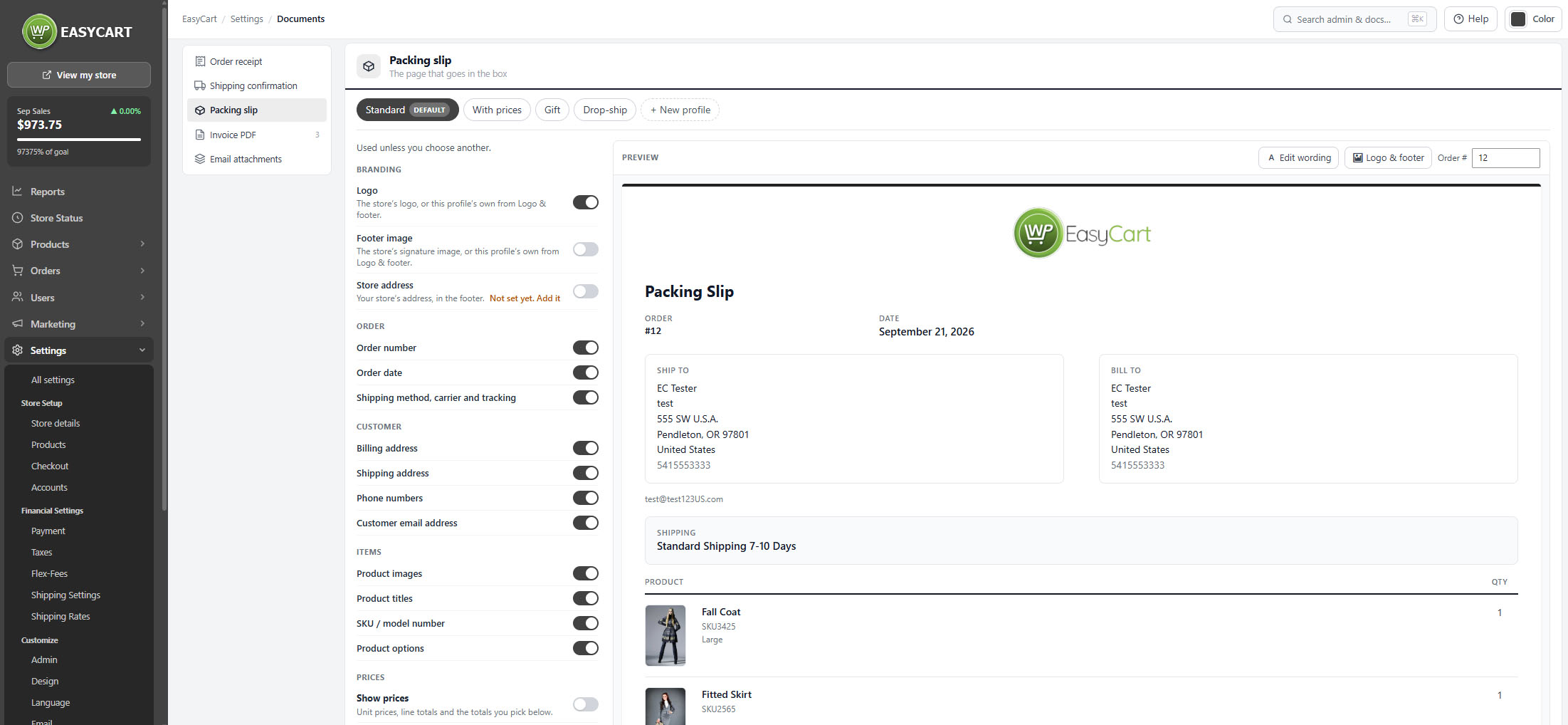
Your registered business name, address and VAT number, printed at the top of the PDF. EU invoices are required to show them, so if you attach PDFs for compliance reasons this field is the compliance. Left empty, the PDF prints your site name instead.
File name
What the attachment is called. {order_id} becomes the order number and {date} the order date. Anything other than letters, numbers, dashes and underscores is removed, and the name always ends in .pdf. A folder full of identically named attachments is useless, so keep the order number in it.
Paper size
Automatic uses US Letter where that is the local standard, such as the United States, Canada and Mexico, and A4 everywhere else. Override it only if you know every recipient prints on one size.
Heading
Invoice or Receipt, chosen per profile and printed at the top of the PDF. Invoice suits a record of payment for accounting; Receipt a plain confirmation that money changed hands. The built-in Receipt profile is headed Receipt, for orders already paid. The invoice email for a manual payment always carries the Invoice heading.
Business details
Whether the business details above print on this profile. Turn it off for a profile you do not want to double as a formal invoice.
Logo
The store logo from Settings › Email, or this profile’s own if it has one under Logo & footer. Size and position follow the same place.
Footer image
The store’s signature image at the foot of the PDF, or this profile’s own. The signature text never prints on the PDF, only the image.
Store address
Your postal address in the footer. Usually redundant when the business details are on, since those carry your address already.
Heading, order number and date
The block at the top right: this profile’s heading, the order number and the date. Keep it on; an invoice without a number and a date is hard to file.
Greeting and thank-you lines
The receipt email’s own lines above the addresses and below the totals. The built-in Bookkeeping profile turns them off for a plainer document.
Shipping address
Where the order was delivered.
Billing address
Who paid. Most invoicing rules expect it.
Customer VAT number
The customer’s VAT number, when they gave one at checkout. Business buyers in the EU need it on the invoice to reclaim VAT.
Customer email address
The customer’s own email address beside their order details. Useful when paperwork is forwarded around an office and somebody needs to know which account ordered.
Product images
A thumbnail against each line. Off makes a lighter, more formal PDF.
SKU / model number
The SKU or model number against each line, which is what a warehouse or a bookkeeper matches on.
Product options
The size, colour or other choices made for each item. Leave it on if you sell anything with variants.
Show prices
Unit prices, line totals and the order totals.
Customer’s order notes
What the shopper typed in the order notes box at checkout. It only prints when order notes are turned on at checkout in the first place.
Email attachments
Which documents go out as PDFs with each email, and with which profile
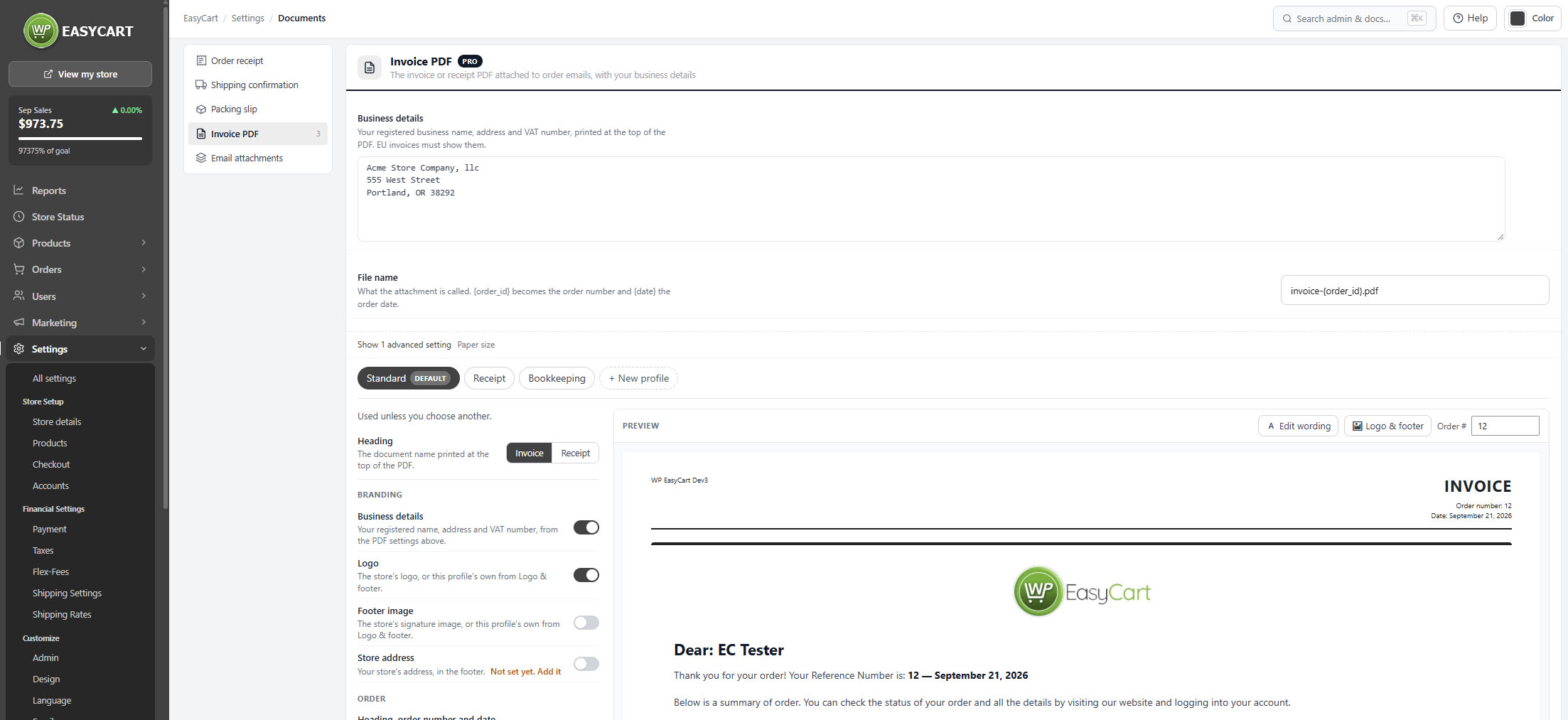
no stored settingsA grid of every email down the side and the two PDFs across the top: Invoice PDF and Packing slip PDF. The emails are the order receipt, the store’s copy of it, the order shipped email and the packing slip email. Each cell is Off, Attach · default, which follows whichever profile is the default when the email is sent, or Attach with a named profile. Cells save as you change them.
Picking a profile per cell is the point of the grid: the buyer’s receipt can carry an invoice with prices while the slip in a gift box carries none. The PDFs need the PHP dom and mbstring extensions on your server; if one is missing a warning names it above the grid, and emails go out without the PDF rather than not at all. Anything here can be changed for a single send from the order screen.