What a Flex-Fee is
A line added to the order, which can also be negative
no stored settingsA Flex-Fee adds a line to the order at checkout. The label you give it is what the customer sees on the cart, the receipt and the invoice, so write it as something a buyer would understand rather than as an internal code.
The useful surprise is that a fee can be negative, in which case it acts as a discount. That makes this one mechanism for handling handling charges, remote area surcharges, card processing costs, and standing wholesale discounts, without needing separate systems for each.
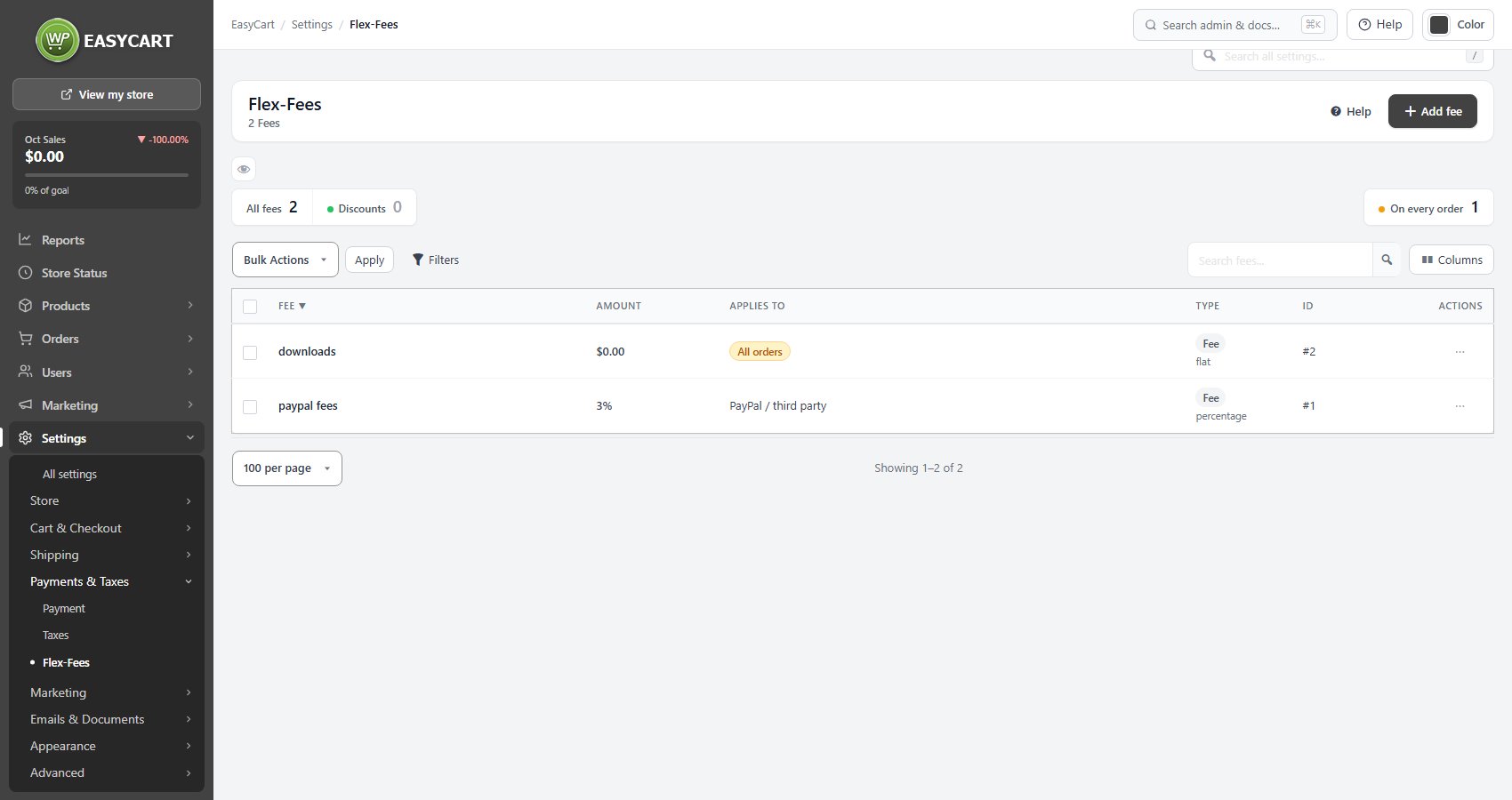
The list shows every fee with its amount, what it applies to and whether it charges or discounts, with counts for all fees, discounts and fees on every order across the top. Inside a fee, Fee health flags one that does nothing, typically because the amount is zero or the minimum is above the maximum.
Fees can be duplicated as a starting point for a similar one. Deleting a fee can be undone for 15 minutes, and orders already placed keep the fee lines they have; only future carts change.
How the amount is worked out
Flat or percentage, and what the percentage is taken from
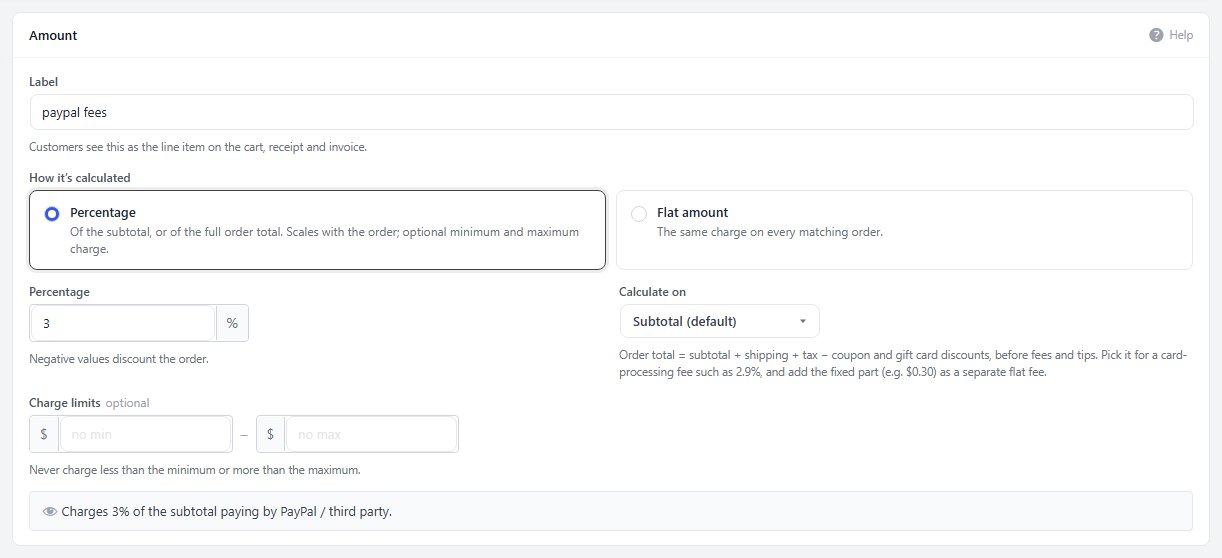
no stored settingsA fee is either a flat amount, the same on every matching order, or a percentage.
For a percentage, what it is calculated on matters a great deal. The default is the subtotal. The alternative is the order total, meaning subtotal plus shipping plus tax minus discounts, and that is the one to use for card processing fees. A card processor charges you on everything it puts through, so a 2.9 per cent fee taken on the subtotal alone leaves you paying the processor on the shipping and tax yourself.
Minimum and maximum limits cap the result, so a percentage fee never becomes absurd on a very large or very small order. The editor refuses a maximum below the minimum rather than accepting a rule that can never be satisfied, and a percentage has to fall between minus one hundred and one hundred. A line under the fields says in words what the fee will do, so you can check it before saving.
When it applies
Eight kinds of condition, combined
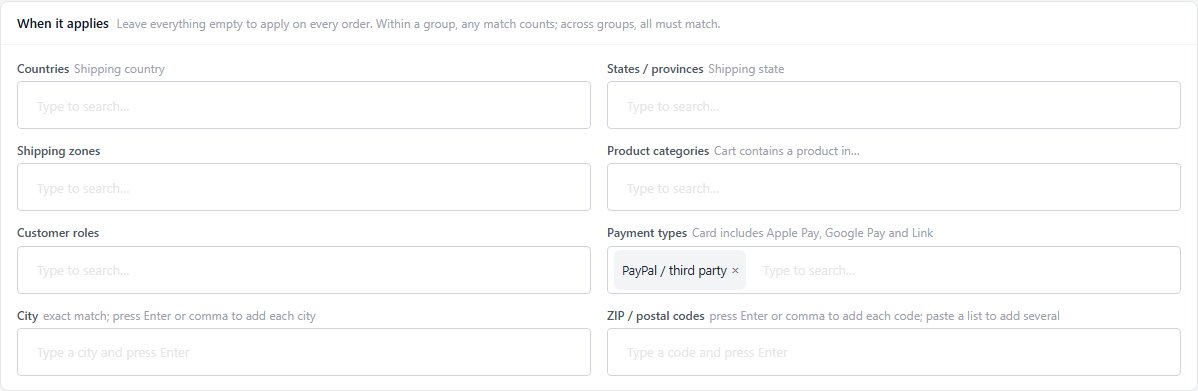
no stored settingsA fee either applies to every order or only to orders that match your conditions. Leave every condition empty and it applies to every order. Within one condition any match counts; across conditions, all must match.
Destination covers shipping country, state or province, city, ZIP or postal codes, and shipping zones. Cities and postal codes are matched exactly and several can be listed, which is how a remote area surcharge is built.
Who is buying covers customer roles, which is how a standing wholesale discount or a trade-only handling charge is applied.
What is in the cart covers product categories, so a fee can attach to hazardous, oversized or fragile goods without touching the rest of the order.
How they are paying covers payment type: card, PayPal or third party, manual payment, Amazon Pay, Affirm, and the Stripe buy-now-pay-later providers Klarna and Afterpay. Card includes Apple Pay, Google Pay and Link, since those are card payments underneath, so a card fee applies to them too. This is what makes an honest card surcharge possible, applied only to the methods that actually cost you.
Ready to run your store on WP EasyCart?
Everything in this guide works with the free plugin. PRO and Premium add subscriptions, memberships, wholesale pricing and more. Try every PRO feature free for 14 days.