
Admin panels › Orders

Subscriptions

Every recurring agreement your store holds, what state it is in, what has been charged against it, and what you can change from here rather than at the payment provider. 4 parts.

Quick links

Where to find it:WP Admin › EasyCart › Orders › Subscriptions

The agreements

List and record

What is running, what is in trouble, and what sits inside an individual subscription.

The subscription list

Every recurring agreement, and which ones need attention

no stored settings

One row per subscription, showing the customer, the product, the amount, when it renews and its current state. The states are worth knowing apart, because they call for different responses.

Active is billing normally. Past due and Payment failed mean money did not arrive and somebody should act. Paused is deliberate and either has a resume date or waits for you. Incomplete never got off the ground. Expired and Canceled have ended.

A health indicator flags the ones in trouble, including how many times an invoice has been retried and whether any retries remain. A subscription whose last retry has passed is not going to fix itself.

The tiles above the list give monthly recurring revenue ( MRR ) and count all, active and trialing subscriptions, those with payment trouble, and those canceled in the last 30 days. Columns chooses which columns the list shows.

For a step by step walkthrough, see How to Sell Subscriptions on WordPress.
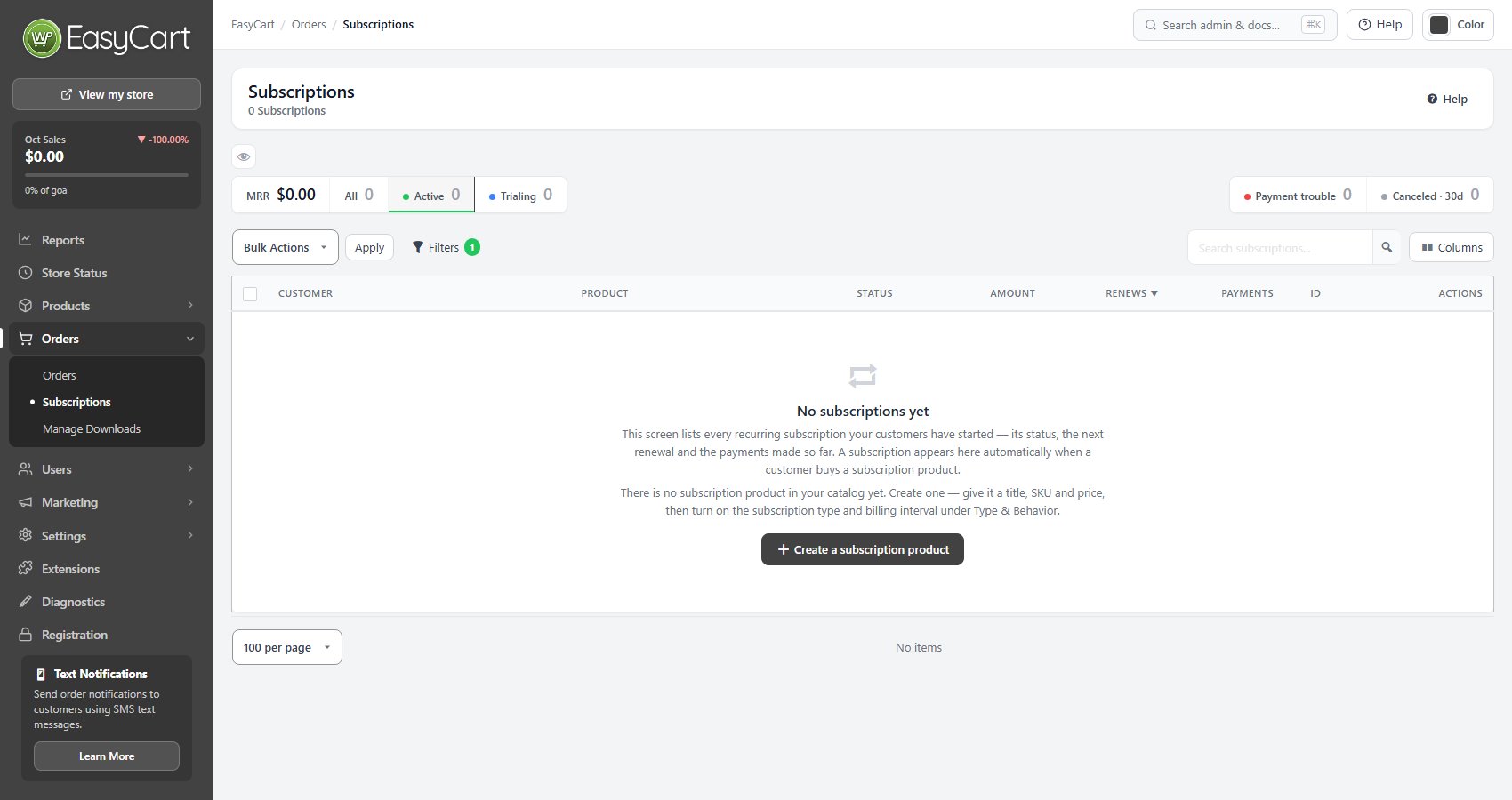
Orders › Subscriptions, showing the list with status, renewal date and health indicators.

Inside a subscription

What was bought, who by, and what has been charged so far

no stored settings

The overview carries the customer details, the product with the options, variants and any sign-up fee from the original purchase, the quantity, the price and the duration. Where nothing extra was chosen, it says so rather than leaving you wondering whether the record is incomplete.

The billing history lists every payment taken, with dates and amounts, and each payment creates a normal order in your store, so the money is visible in reports and the customer gets a receipt like any other purchase. Refunds against those payments are recorded here too.

If the same customer holds more than one subscription, the others are linked from the record, which saves hunting when somebody asks you to change all of them.

💡 Note: Each payment creates a normal order, so subscription revenue appears in Reports and in Order Management alongside one-off sales rather than being counted separately.

Managing them

Providers and actions

Where the billing really lives, and the difference between pausing, cancelling and deleting.

Stripe and PayPal

Where the billing actually lives, and what that means for what you can change

no stored settings

The subscription record in your store mirrors an agreement held at the payment provider, and which provider it is decides what you can do from here. Subscription products can only be bought while Stripe takes your card payments, so new subscriptions are Stripe ones; PayPal records are agreements made through PayPal.

For Stripe, the screen reads across: the card on file, the invoices, and whether your record is in sync. Stripe invoices can be loaded on demand, and an active Stripe subscription can have its product changed. If there is no default payment method on file, the screen says so plainly, because that is the single most common reason a renewal fails. Customers update their card from the subscription on their account page, and Stripe then pays any open invoice.

For PayPal, the billing agreement is managed at PayPal, not here. Cancelling in WP EasyCart marks the record cancelled and tells you in as many words to cancel the agreement at PayPal as well. Miss that step and the customer keeps being charged by a subscription your store believes is over.

For a step by step walkthrough, see How to Offer Upgrade and Downgrade Plans.

⚠️ Careful: Cancelling a PayPal subscription here marks your record cancelled but does not stop PayPal billing the customer. The billing agreement has to be cancelled at PayPal as well. Stripe subscriptions do carry the cancellation through.

Pausing, cancelling and deleting

Three different things, and only cancelling stops the billing

no stored settings

Pausing stops billing without ending the agreement, either until a date you set or until you resume it manually. This is the right answer for a customer going away, a seasonal break, or a delivery problem you need time to fix.

Cancelling ends the agreement. On Stripe you choose when: now, at the end of the current period, or on a date you pick, and cancelling now can also refund the last payment. A scheduled cancellation can be removed again before it happens. On PayPal the record is marked canceled here, and you must cancel the billing agreement at PayPal too.

Deleting removes the record from your store; the orders it created keep their history. It sits in a danger zone for good reason, and it is not available while the subscription is still active in Stripe: cancel it first, so the customer is never billed with no record here. A delete can be undone for 15 minutes.

⚠️ Careful: Deleting never stops billing. If you want billing to stop, cancel. Delete only a record whose agreement has already ended and that you no longer want.

Keep going

Related panels

Subscription Plans

The plans that define durations and pricing.

Order Management

The orders each subscription payment creates.

Accounts

Letting shoppers manage their own subscriptions.

Email

Trial, renewal and payment failure emails.

Payment

The Stripe and PayPal connections behind the billing.

User Accounts

The customers holding these subscriptions.

Ready to run your store on WP EasyCart?

Everything in this guide works with the free plugin. PRO and Premium add subscriptions, memberships, wholesale pricing and more. Try every PRO feature free for 14 days.
The WP EasyCart admin: orders and offers
Updated on October 2, 2026