Settings › Store
Product Settings
Who can shop, what a product page and the store page show, prices, stock, what happens after Add to cart, reviews, search and inquiry spam. First the guided page card by card, then every setting as one list. 23 sections.
Quick links
Where to find it:WP Admin › EasyCart › Settings › Store › Products
The page
Products, card by card
What the page says about your catalog, then each card in the order it shows them, with the page beside it.
The page at a glance
How products look, sell and stay in stock on your store
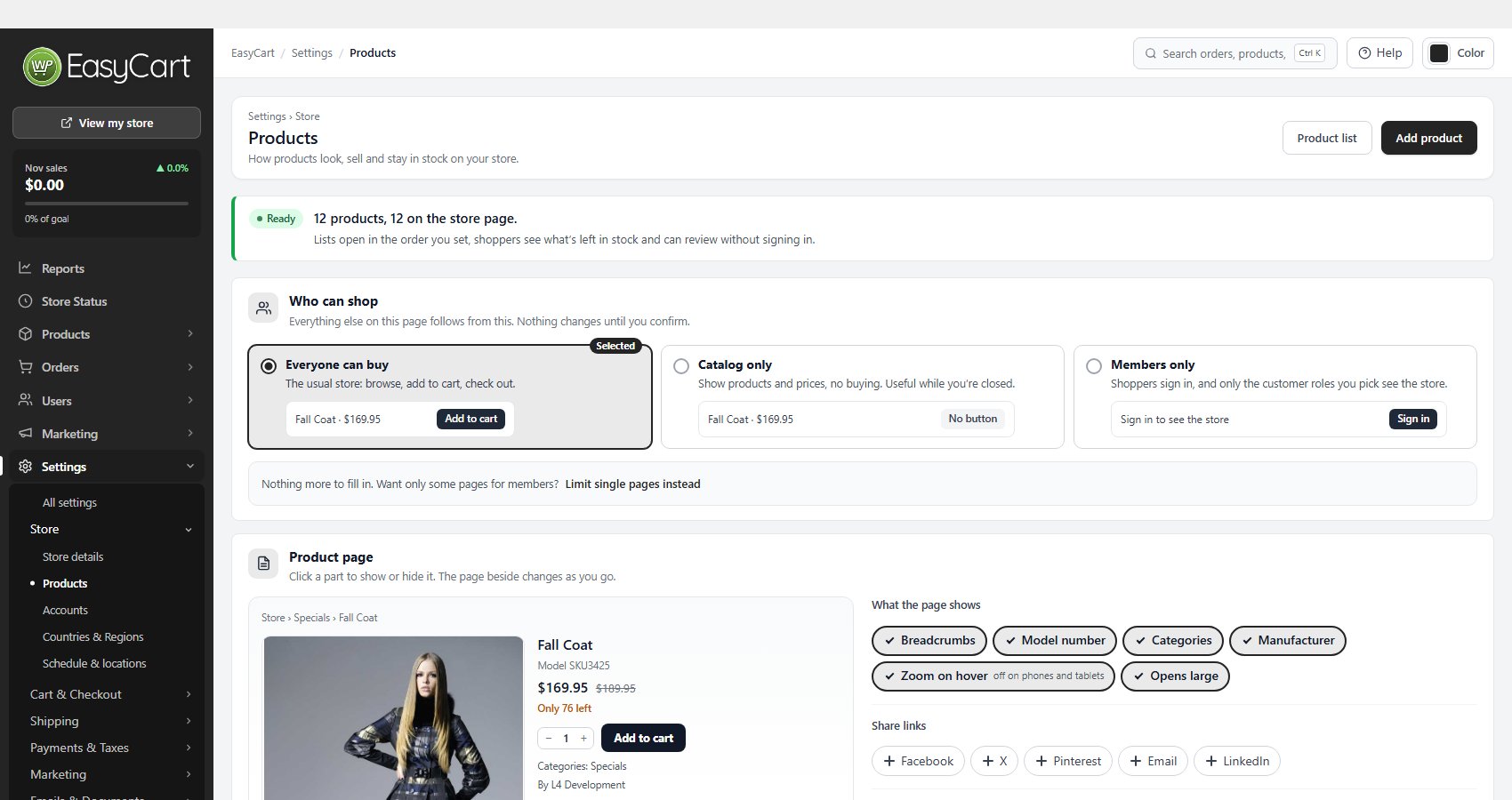
Settings › Store › Products opens as a guided page. The top line counts your products and how many are on the store page, then says in a sentence how lists open, whether shoppers see stock and who can review. Product list and Add product at the top open your products. Each card shows what shoppers see beside its controls, and the picture changes as you click. Most switches save as you change them. Worth a look appears when something needs you, such as a price filter with no price ranges.
Who can shop
Everything else on this page follows from this
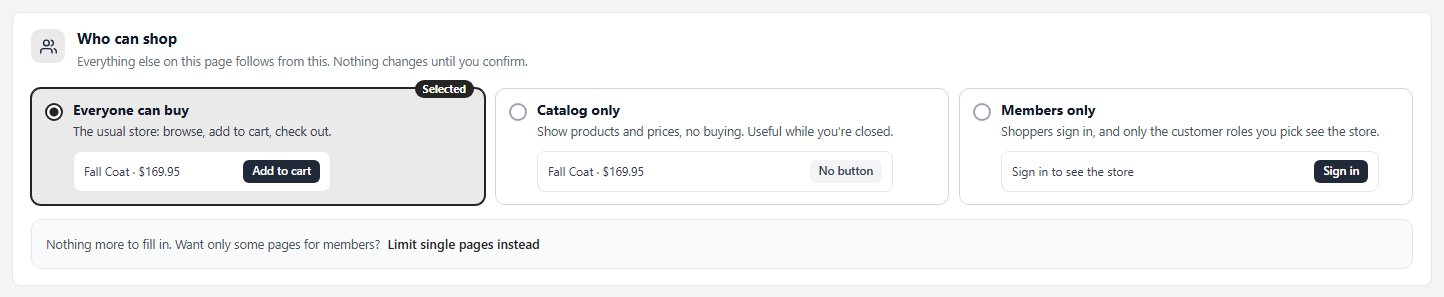
One question that decides the rest. Everyone can buy is the usual store: browse, add to cart, check out. Catalog only shows products and prices with no buying, useful while you are closed. Members only makes shoppers sign in, and only the customer roles you pick see the store. Each choice shows what a product card looks like with it, and nothing changes until you confirm in the window that opens, where Members only picks its roles. To keep only some pages for members, Limit single pages instead opens Limit Access.
💡 Note: For a step by step walkthrough, see How to Make a Members-Only Store.
Product page
Click a part to show or hide it
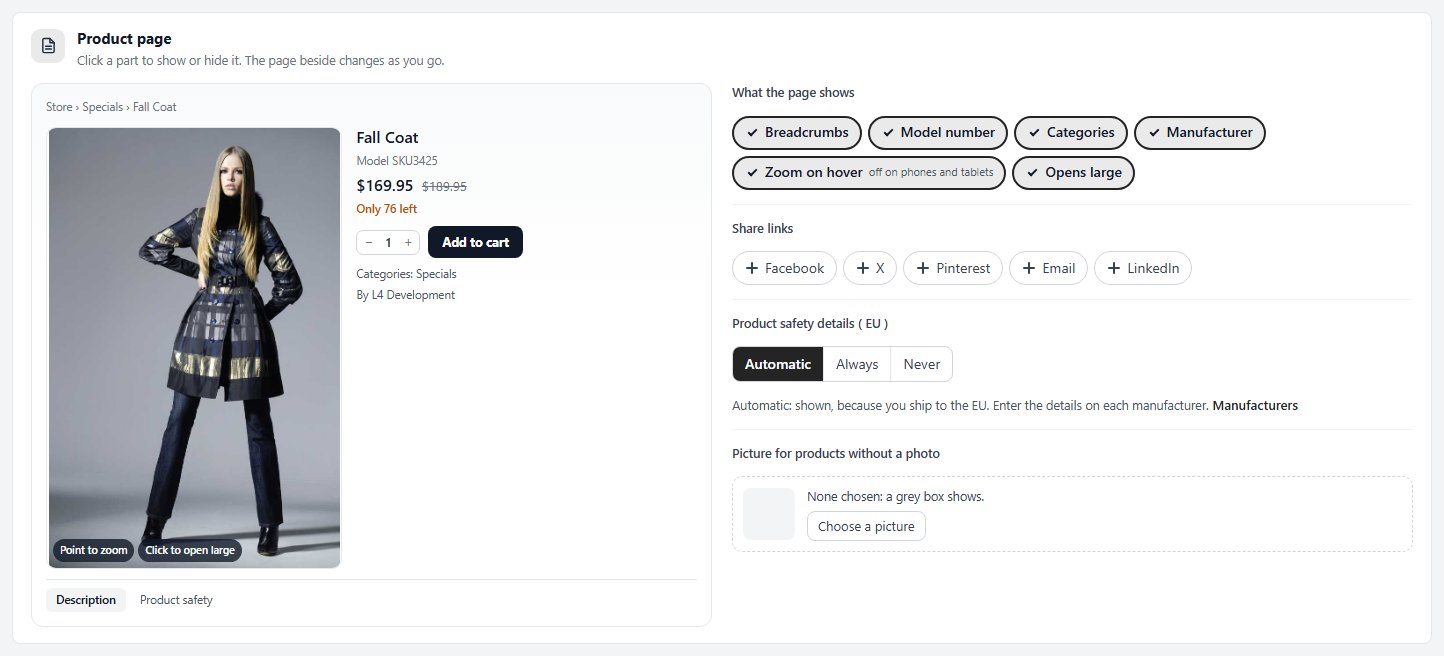
A product page drawn with your settings, beside the parts it can show. Click a part to show or hide it: Breadcrumbs, Model number, Categories, Manufacturer, Zoom on hover ( off on phones and tablets ) and Opens large. Under Share links pick Facebook, X, Pinterest, Email and LinkedIn. Product safety details ( EU ) is Automatic, Always or Never, and says what Automatic does for your store. Picture for products without a photo replaces the grey box with a picture you choose.
Store page
How lists of products are sorted, split and filtered
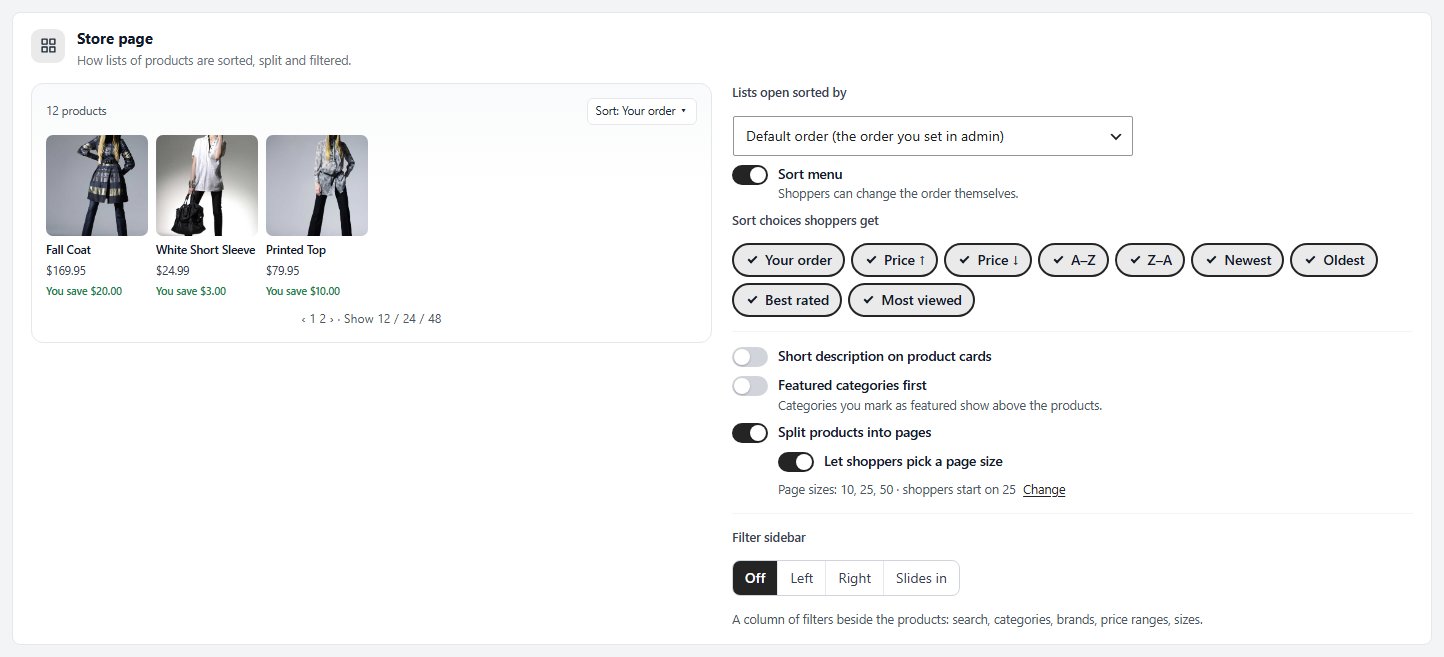
A store page drawn with your settings, beside how lists are sorted, split and filtered.
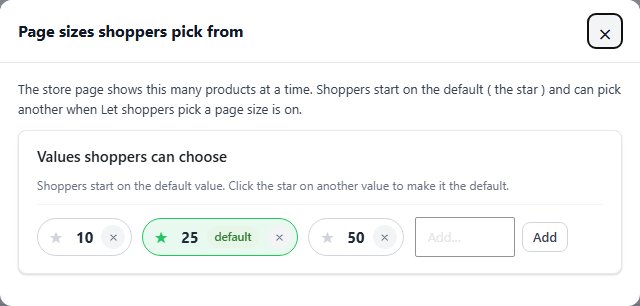
Lists open sorted by sets the first order. Sort menu lets shoppers change it, and Sort choices shoppers get picks which orders it offers. Then Short description on product cards, Featured categories first, Split products into pages and Let shoppers pick a page size. The line under them names your page sizes and the one shoppers start on; Change opens Page sizes shoppers pick from in a window, where you add a size, remove one, or click its star to make it the default.
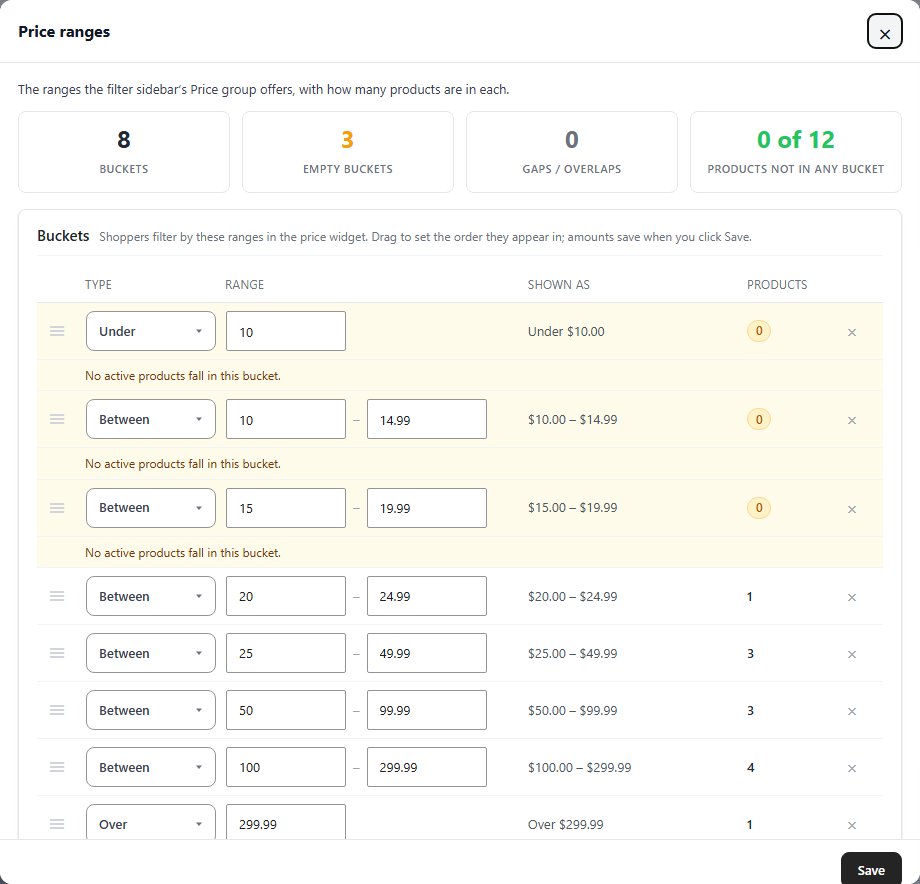
Filter sidebar: Off, Left, Right or Slides in ( shoppers open it with a Filters button ). With the sidebar on, click the groups it shows, such as search, categories, manufacturers, price, option filters and the pickup location ( PRO ). The categories, manufacturers and option sets to filter by are found as you type their names, and the price group lists your price ranges: Change or Add price ranges opens Price ranges in a window, with how many products fall in each.
💡 Note: Per page options and Price points left the Settings menu: their lists open here, in windows. Their old addresses still open the full lists; see Per Page Options and Price Points.
Prices
What shoppers see around a price
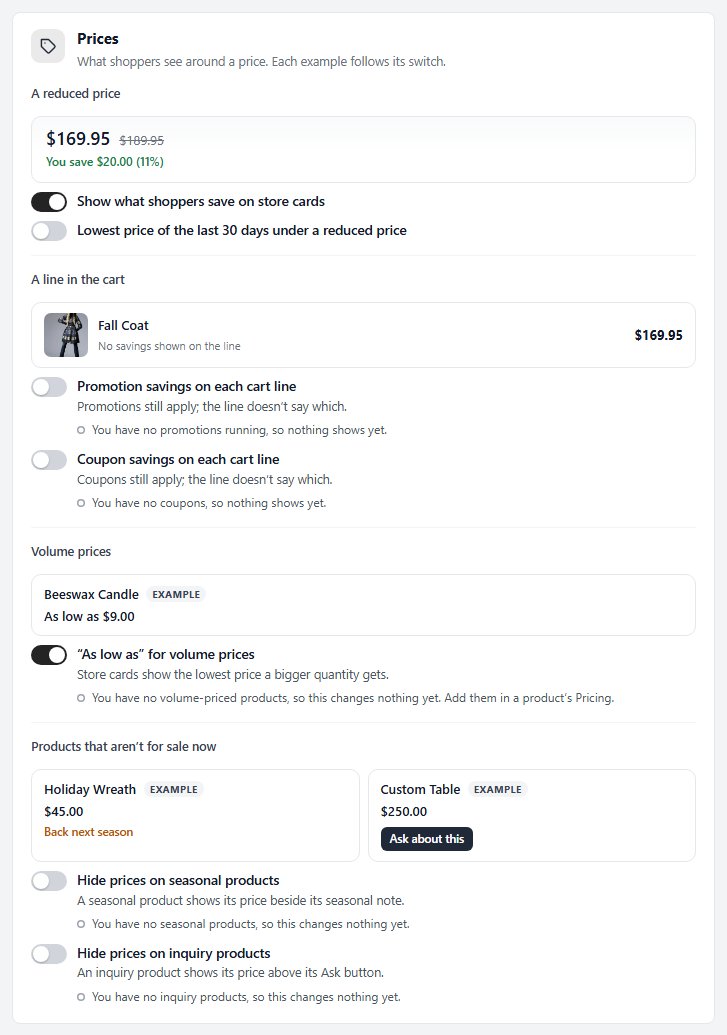
Each switch sits under an example that follows it. A reduced price: Show what shoppers save on store cards and Lowest price of the last 30 days under a reduced price. A line in the cart: Promotion savings on each cart line and Coupon savings on each cart line. Volume prices: “As low as” for volume prices. Products that aren’t for sale now: Hide prices on seasonal products and Hide prices on inquiry products. Where your store has nothing a switch acts on yet, such as no coupons, the card says so and marks its example EXAMPLE.
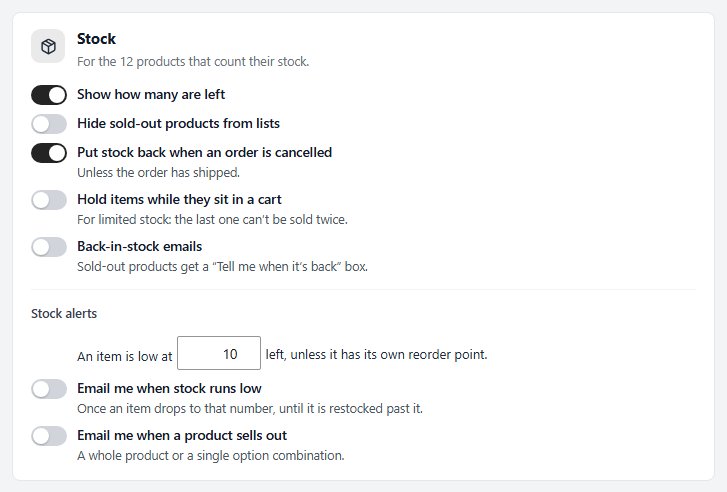
Stock
For the products that count their stock
For the products that count their stock: Show how many are left, Hide sold-out products from lists, Put stock back when an order is cancelled ( unless it has shipped ), Hold items while they sit in a cart and Back-in-stock emails ( PRO ). Under Stock alerts, set the number at which an item is low, then Email me when stock runs low and Email me when a product sells out.
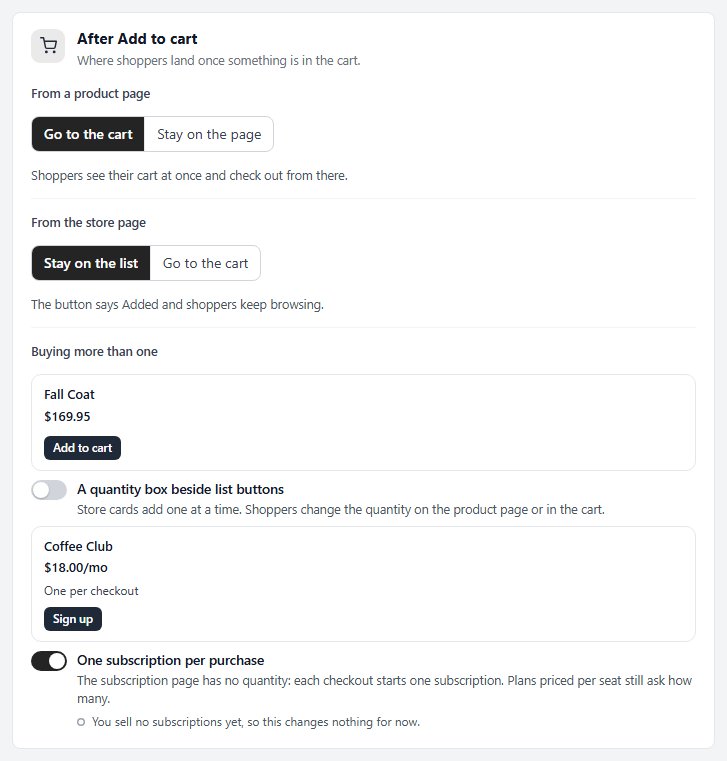
After Add to cart
Where shoppers land once something is in the cart
From a product page: Go to the cart or Stay on the page. From the store page: Stay on the list or Go to the cart. A sentence under each says what the shopper sees. Buying more than one: A quantity box beside list buttons ( PRO ), and One subscription per purchase, so each checkout starts one subscription ( plans priced per seat still ask how many ).
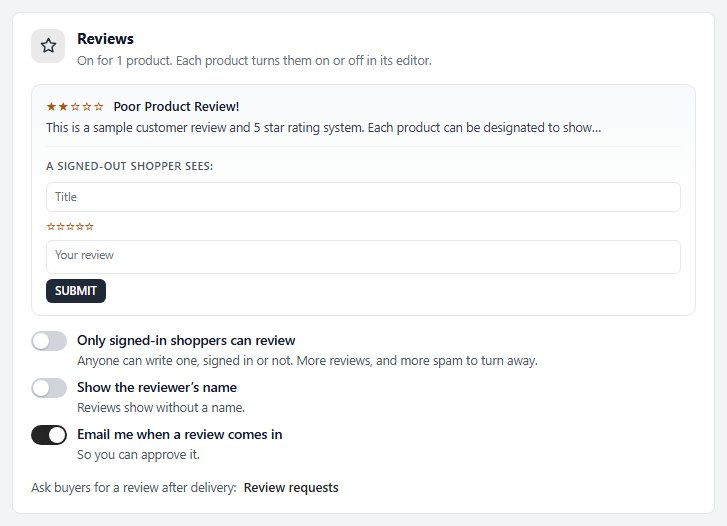
Reviews
Who can write one, and what shows
Says how many products take reviews ( each product turns them on in its editor ) and shows a review and the form a signed-out shopper sees. Only signed-in shoppers can review, Show the reviewer’s name and Email me when a review comes in, so you can approve it. A link opens review requests, which ask buyers for a review after delivery.
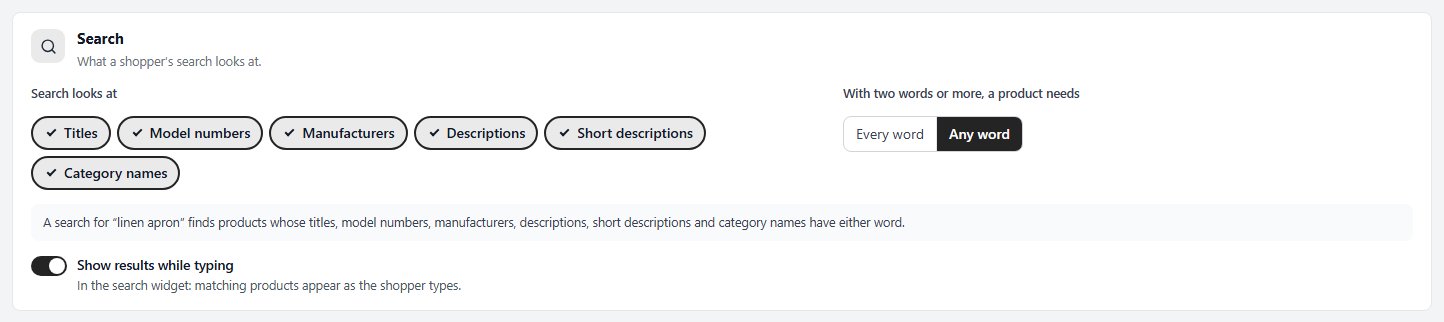
Search
What a shopper’s search looks at
Search looks at: titles, model numbers, manufacturers, descriptions, short descriptions and category names; click one to leave it out. With two words or more, a product needs Every word or Any word, and a sentence says what a two-word search finds. Show results while typing shows matching products in the search widget as the shopper types.
Inquiry form protection
Three levels, and every limit under Customize
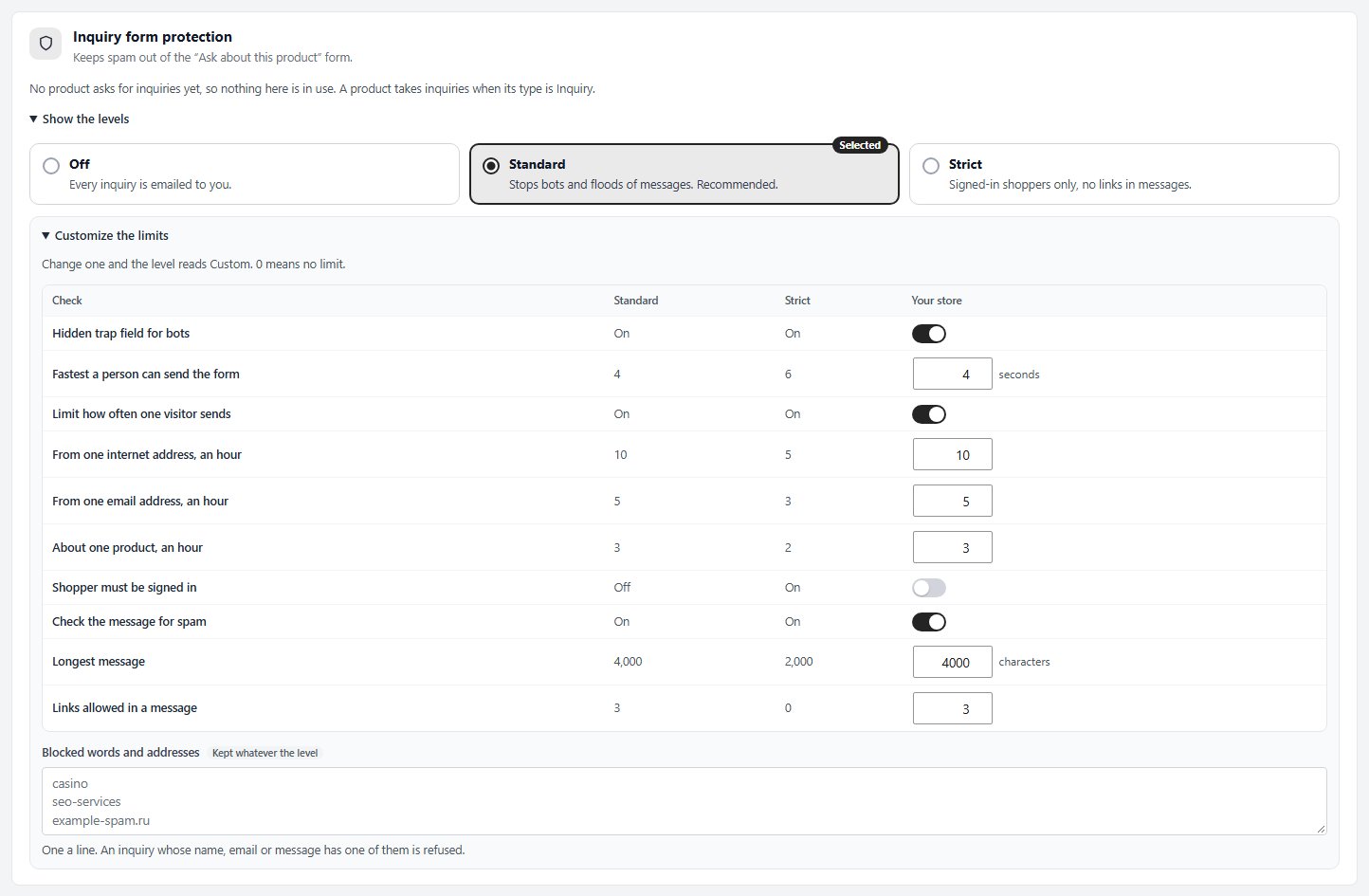
Keeps spam out of the “Ask about this product” form on inquiry products. Show the levels opens three: Off ( every inquiry is emailed to you ), Standard ( stops bots and floods of messages; recommended ) and Strict ( signed-in shoppers only, no links in messages ). Customize the limits shows every check with its Standard and Strict value beside yours: the hidden trap field, the fastest a person can send the form, how often one visitor, email address or product may send in an hour, signing in, the spam check, the longest message and the links allowed. Change one and the level reads Custom. Blocked words and addresses are kept whatever the level.
Fine-tune
The other settings, as switches
The settings no card draws, as switches that save as you change them: the image and details column split, the short description below the Add to cart button, the separator between the model number and option codes, keeping the Add to cart button after adding, counting each option combination separately for volume pricing, prices both with and without VAT, logging refused inquiries, and products per export file. Each is explained, with its default, in the list below.
As one list
How products look
Products, as one list, under All settings at the foot of the page, shows every setting in its section: whether shoppers can buy, what a product page shows and shares, and how lists behave.
Catalog mode & access
Pause selling, or limit who can see the store
4 settingsCatalog mode
Turns the whole store into a browsable catalog. Every Add to cart button disappears, the cart and checkout stop accepting items, and prices still show unless you hide them further down in Pricing display. Use it while you are on vacation, while you are still loading products, or permanently if you list products online but take the order by phone. Nothing is deleted and nothing is unpublished, so switching it back off restores normal selling instantly.
Text shown where the Add to cart button was
Replaces the missing Add to cart button with a short line of your own, so the product page does not simply end in blank space. Keep it to a few words, such as a return date or “Call to order”. Leave it empty and nothing is printed at all.
Banner above products and the cart
A single message printed across the top of product pages and the cart while catalog mode is on. This is the one shoppers actually read, so put the explanation here and keep the button text short. Leave it empty to show no banner.
Who can view the store
Controls who is allowed to see the store at all. Leave it on No restrictions for an ordinary public shop. Pick one or more customer roles instead and anyone who is not signed in with one of those roles is asked to log in before any product is shown. This is how wholesale-only, members-only and dealer stores are built. Roles come from your customer role list, and admin-level roles are deliberately not offered here.
⚠️ Careful: While catalog mode is on nobody can buy anything, including you. The Add to cart button and the cart are both withdrawn store-wide, so switch it off again before you test an order. On the guided page this is Catalog only, under Who can shop. For a step by step walkthrough, see How to Make a Members-Only Store.
Product pages
What appears on a single product’s page
11 settingsBreadcrumb links
Prints the Store › Category › Product trail above the product title. Worth keeping on: it gives shoppers a one-click way back to the category they were browsing, and search engines use it to understand how your catalog is organised.
Show the model number
Shows the product’s model number, also called the SKU, near the title. Keep it on if customers order by part number or if your support team asks for it. Turn it off for consumer goods where an internal code only adds clutter.
Show the product’s categories
Lists every category the product belongs to, each one linked back to that category’s listing. A cheap way to keep shoppers browsing after they land on a product from a search engine.
Show the manufacturer
Names the product’s manufacturer and links to everything else that manufacturer makes. Useful when customers shop by brand; pointless if every product in your store is your own.
Show product safety details ( EU )
EU product safety rules ( GPSR ) ask a shop selling to consumers in the EU to show, with each product, who made it and how to reach them, a responsible person in the EU when the manufacturer is outside it, and the product’s warnings. This adds a Product safety tab to the product page with the manufacturer’s name, postal address, email and website, the responsible person in the EU, the product’s name, SKU and barcode, and its warnings and safety information. Automatic shows it when your store is in the EU or the EEA, or sells there: you narrowed your ship-to countries and kept an EU country among them, or you shipped an order to one in the last year.Always show and Never show decide for you. The tab only appears on products with something to show. Enter the contact details once on each manufacturer, under Products › Manufacturers, and the warnings on each product, in the editor’s Storefront section. The Elementor Product Tabs widget and the Tabs extension show the tab too.
Zoom on image hover
A magnifier panel follows the cursor across the main product image so shoppers can inspect detail without opening anything. It is automatically skipped on phones and tablets, where there is no cursor to follow, so leaving it on costs mobile visitors nothing.
Open images in a lightbox
Clicking the main image opens a full-size version in a lightbox over the page. Pairs well with the hover zoom above: zoom for a quick look, lightbox for a proper one.
Image and details column split
Splits the product page between the image column and the details column, in five per cent steps from 5/95 to 95/5. Theme default lets your theme decide. Raise the image share for photography-led products, lower it when you have long option lists or detailed specifications to fit. A details_sizing attribute on an individual shortcode still wins over this setting.
Short description below the Add to cart button
Moves the short description underneath the Add to cart button instead of above it. Above suits a sales line that helps the shopper decide; below suits care instructions or small print that would otherwise push the button off the screen.
Placeholder image for products without a photo
The image used anywhere a product has no photo of its own, including cart lines and order records. Paste the full URL of an image from your media library. A plain logo or a neutral box shot keeps listings looking finished while you are still photographing stock.
Separator between the model number and option codes
The character placed between a product’s model number and the codes of the options a shopper picked, so a red large shirt reads SHIRT-RED-L. Change it to match the SKU format your warehouse, accounting package or shipping software expects.
💡 Note: The product safety details are entered on each manufacturer and product. For a step by step walkthrough, see How to Show EU Product Safety (GPSR) Details.
Social sharing
Share links shown on every product page
9 settingsFacebook share link
Adds a Facebook share icon to every product page. Shares carry your product image and title through to the post, so it is worth checking a product looks right in a preview before you promote it.
X (Twitter) share link
Adds an X share icon, formerly Twitter, to every product page.
Pinterest share link
Adds a Pin it icon. The most valuable of the share links for visual products such as clothing, homeware, craft supplies and food, because pins keep sending traffic long after they are posted.
Email share link
Adds a share-by-email icon that opens the visitor’s own mail program with the product link filled in. Popular on business and trade stores where a buyer forwards a product to a colleague for approval.
LinkedIn share link
Adds a LinkedIn share icon. Sensible on industrial, professional and business-to-business catalogs, rarely used elsewhere, which is why it is off by default.
Delicious share link
Adds a Delicious bookmark icon. The service is effectively closed; the option remains only so stores that once used it are not changed underneath them. Leave it off.
MySpace share link
Adds a MySpace share icon. Kept for backwards compatibility with very old stores. Leave it off.
Digg share link
Adds a Digg share icon. Kept for backwards compatibility. Leave it off.
Google+ share link
Adds a Google+ share icon. Google+ shut down in 2019 and the link no longer goes anywhere useful, so turning this on will only give shoppers a dead icon. Leave it off.
Product lists
The store page, category pages and other product grids
15 settingsSort menu
Shows the sort menu above product lists. Turning it off hides the menu and every sort choice with it, and the list is simply ordered by the default you set below. Ten individual sort choices sit behind the advanced fold so you can offer only the ones that make sense for your catalog.
Default sort order
The order products appear in before a shopper touches the sort menu. Default order uses the priority you set on each product in admin, which is the right answer for a curated store. Newest first suits stores with regular new arrivals; price low to high suits price-sensitive categories.
“Default order” sort option
Offers your own admin-defined order as a choice in the sort menu.
“Price, low to high” sort option
Offers cheapest first. Usually worth keeping.
“Price, high to low” sort option
Offers most expensive first.
“Title, A to Z” sort option
Offers A to Z by title.
“Title, Z to A” sort option
Offers Z to A by title. Rarely used; a candidate to switch off to keep the menu short.
“Newest first” sort option
Offers most recently added first. Valuable if you add stock often.
“Oldest first” sort option
Offers longest-listed first. Useful for clearing older stock.
“Best rated” sort option
Offers highest review rating first. Only meaningful once you have a reasonable number of reviews, so consider leaving it off on a new store.
“Most viewed” sort option
Offers most-visited products first, which works as an informal popularity sort.
Short description on grid tiles
Prints each product’s short description under its title on grid tiles. Adds useful context on technical catalogs, but uneven description lengths can make a tidy grid look ragged, so check a full category page after turning it on.
Featured categories first on the store page
Puts your featured categories above the product grid on the first page of the store, turning the store landing page into a department-style entry point instead of a wall of products. Only the first page is affected, so shoppers who page onward still see an uninterrupted grid.
Split products into pages
Splits long product lists across numbered pages. Turning it off puts every product on a single page, which is fine for a few dozen products and painfully slow for a few thousand. The page sizes on offer are edited from the guided Store page card: Change opens Page sizes shoppers pick from.
Let shoppers pick a page size
Shows the per-page menu so shoppers can choose how many products to load at a time. The choices in that menu, and which one is starred as the default, are set in Page sizes shoppers pick from, which Change on the Store page card opens.
💡 Note: The page sizes, and which one shoppers start on, are edited from the Store page card above: Change opens Page sizes shoppers pick from. This section only decides whether paging and the per-page menu appear at all.
As one list
What happens when they buy
The moment after Add to cart, how prices and savings are written, and how stock is counted.
Add to cart flow
What happens the moment a shopper adds a product
5 settingsStay on the product page after adding to cart
Keeps the shopper on the product page after they add it, so they can carry on browsing. Turning it off sends them straight to the cart, which suits stores where most orders are a single item. The view-cart bar appears either way, so nobody loses track of what they have added.
Go straight to checkout when adding from a list
Sends the shopper straight to checkout the moment they add a product from a grid or list, turning every tile into a buy-now button. Effective for single-item stores such as tickets, memberships and downloads; harmful anywhere shoppers normally build a basket.
Keep the Add to cart button after adding
By default a list product’s Add to cart button changes to Checkout once that product is in the cart, which stops accidental duplicates. Turn this on to keep the Add to cart button visible instead, so a shopper can add the same product again from the list.
Quantity box beside list Add to cart buttons
Puts a quantity box next to the Add to cart button on grid and list tiles, so shoppers can order six of something without opening the product. It only appears on products that have no options to choose, because a quantity is meaningless until the shopper has picked a size or a color.
One subscription per purchase
Removes the quantity box from subscription products so each purchase starts exactly one subscription. A subscription is a sign-up rather than a retail line, and buying “three” of one almost never means what the shopper thought it did. Leave it on unless you genuinely sell subscriptions in multiples.
Pricing display
How prices, discounts and tiers are shown
9 settingsShow promotion savings on each line
Prints the amount a promotion took off, on the product page and on every cart and order line it touches. Showing the saving in cash terms makes a promotion feel concrete, and it heads off support questions about why an order total is lower than expected.
Show coupon savings on each line
The same for coupons: each line shows what the coupon knocked off it. Useful when a coupon only applies to part of the basket, since the shopper can see exactly which lines were discounted.
Show the lowest price of the last 30 days under a reduced price
EU price rules say that a store announcing a reduction must show the lowest price it charged in the 30 days before it. With this on, a product whose price is below its compare-at price shows Lowest price in the last 30 days: and the amount under the price, on product pages and in store lists. While an offer lowers a price, the price before the offer is crossed out and the figure counts back from today. The store keeps a price history for it, recorded on every product save, on imports and in a daily check, and variants with their own price keep their own. A reduction that began before that history existed has no earlier price on record: enter it in the product editor’s Lowest price in the last 30 days card, under Pricing. Never saved, the setting is on for stores in the EU and off elsewhere.
Show what shoppers save on store cards
Prints You save with the amount and the percentage, such as You save $13.00 (50%), under a reduced price on product cards: the store page, category and manufacturer lists, quick view, the product widgets and the featured products on a product page. It shows for a running offer’s price and for a compare-at price above the price. Cards with a price range, a label in place of the price, a hidden price, a price per square foot, a subscription or a donation never show it. Change the words in the language editor. On unless you switch it off.
Hide prices on seasonal (catalog-only) products
Products marked seasonal cannot be bought, and this also removes their price. Turn it on when last season’s price would mislead, and off when you want shoppers to see the price they will pay when the product returns.
Hide prices on inquiry products
Products that show an inquiry form instead of an Add to cart button also drop their price. This is the normal choice for made-to-order, quoted and trade-priced goods, where the price depends on the specification you agree with the customer.
Show volume pricing as “as low as”
Products with volume price tiers show their lowest tier price in listings, prefixed “as low as”. It advertises your best price honestly without implying every shopper pays it. Turn it off to show the single-unit price everywhere instead.
Count each option combination separately for volume pricing
Decides how quantity is counted towards a volume price tier. On, each option combination counts on its own, so ten small shirts and ten large shirts are two lots of ten. Off, every variant of the product is added together into one lot of twenty. Off is the friendlier answer for apparel; on suits products where each variant is separately manufactured or separately priced.
Show prices both with and without VAT
Shows both the VAT-inclusive and the VAT-exclusive price, which some markets require and most trade customers prefer. It only produces two different numbers if VAT is enabled and your prices are entered inclusive of VAT; otherwise both figures come out identical and the display just looks broken.
💡 Note: Unit prices, such as €13.27 / kg, are set on each product, in the editor’s Pricing section: see Pricing and Tax. Selling in the EU as a whole is walked through in Set Up VAT or GST for Your Country.
Inventory
Stock counts, reservations and out-of-stock products
7 settingsShow remaining stock on products
Prints how many are left on product pages, which is the classic nudge for anything running low. Turning it off hides stock levels across the entire store and overrides whatever each individual product says, so it is a much bigger switch than it looks. Leave it on and hide stock per product instead if you only want it quiet on a few items.
Hide out-of-stock products from lists
Removes sold-out products from listings entirely. Off keeps them visible with an out-of-stock notice, which is usually better: the page keeps its search ranking, and shoppers can still ask to be told when it returns. Hide them when a product is gone for good.
Reserve stock while an item sits in a cart
Normally stock comes off when an order is placed. Turn this on and it comes off the moment a shopper adds the item, then goes back on the shelf if they never check out. It prevents the race for the last unit on limited releases, ticketed events and one-off items, at the cost of temporarily hiding stock from other shoppers.
Reservation length
How long an item stays reserved once it is in somebody’s cart, measured in the unit below. Long enough for a real shopper to finish checkout, short enough that an abandoned cart does not lock up your stock. An hour suits most stores; minutes suit high-demand releases.
Reservation unit
The unit the reservation length is measured in. Seconds and minutes exist for flash sales and ticketing; hours is the everyday choice.
Put stock back when an order is cancelled
When you move an order to Cancelled, the stock it took goes back, less anything a refund already put back. An order that has shipped keeps its stock, and a note on the order says so, so you can adjust the count under Products › Inventory when the items actually come back. Move the order back out of Cancelled to a paid status and the stock is taken again. Turn it off if you count returned stock by hand. The gift card balance a cancelled order used has its own switch, under Settings › Checkout › Cart page.
Let shoppers ask for a back-in-stock email
Adds a “notify me” box to out-of-stock products so shoppers can leave an email address. When you restock, everyone waiting is emailed automatically. The list of people waiting is managed from each product’s stock tab, and it doubles as evidence of which products are worth reordering.
⚠️ Careful: Show remaining stock on products is a store-wide override. Switching it off hides stock levels on every product regardless of that product’s own setting. If you only want stock hidden on a few items, leave this on and set it per product. For a step by step walkthrough, see How to Manage Inventory and Stop Overselling.
As one list
Filters and search
The sidebar of filters beside your product list, and what the search box actually matches against.
Store sidebar
The filter column beside the product list
17 settingsStore sidebar
Adds a filter column beside your product list, built and styled by WP EasyCart rather than by your theme. This is the master switch: search, category links, manufacturer links, price ranges, option filters and pickup locations all live inside it and none of them appear until it is on. It is usually a better bet than a theme sidebar because it knows about your catalog.
Sidebar position
Choose a fixed column on the left or the right, or a panel that slides in from either side when the shopper taps a Filters button. Slide-in keeps the full page width for products, which is the better choice on image-heavy stores and on narrow themes.
“Clear filters” link
Adds a link that clears every active filter in one click. Worth keeping on as soon as you offer more than one or two filters, since shoppers who filter themselves into an empty result otherwise just leave.
Search box
Puts a product search field at the top of the sidebar. What that search matches is controlled in the Search section further down this page.
Category links
Adds a plain list of category links to the sidebar. This is straightforward navigation, one category at a time, as opposed to the tick-box filter groups below which can be combined.
Categories to link
Pick exactly which categories appear in that list. Start typing and matching categories are offered; each one you choose is added as a chip you can remove. Sub-categories show their parent’s name alongside them, so two categories called “Accessories” can be told apart. Leave it empty and no category links are printed.
Category links above option filters
Puts the category links above the option filters. Turn it off to lead with options such as size or color instead, which suits stores where shoppers shop by attribute rather than by department.
Category filter groups
Builds tick-box filter groups out of one branch of your category tree. You nominate a single top-level category; its sub-categories become the filter group headings, and their own sub-categories become the tick boxes inside each group. It is the most powerful filtering WP EasyCart offers and it needs your categories organised for the job, so plan the branch before you switch this on.
Top-level category for the filter groups
The single category that the filter groups are built from. Everything one level below it becomes a group heading and everything two levels below becomes a selectable filter. Start typing to find it. Clear the field to switch the groups off without losing the rest of your sidebar.
How selections combine across groups
Match all groups narrows the results: a product must match something in every group the shopper has used, so choosing Red and Large returns only red large items. Match any group widens them, returning everything red plus everything large. Match all is what most shoppers expect from a filter.
Filter groups start
Whether the filter groups load already expanded, all collapsed, or with only the first one open. Expanded shows shoppers what is available; collapsed keeps a long list of groups manageable. First expanded is a good middle ground when you have more than about four groups.
Manufacturer links
Adds a plain list of manufacturer links to the sidebar. Only worth it if you stock several brands and customers know which one they want.
Manufacturers to link
Pick which manufacturers appear in that list. Start typing to find one; each choice becomes a chip you can remove. Leave it empty and no manufacturer links are printed.
Price filter
Adds a price filter to the sidebar, listing the price ranges you set in the Price ranges window ( Change or Add price ranges, beside the filter sidebar on the Store page card ) with a live count of how many products fall in each. Define the ranges first, otherwise there is nothing for the filter to show. Also available as an option on the Elementor Store element.
Option filters
Lets shoppers filter by option values such as size, color or material. Which option sets are offered is chosen directly below.
Option sets to filter by
Each option set you choose here gets its own block of filters in the sidebar, listing that set’s values. Start typing to find a set. Choose the two or three attributes shoppers actually shop by rather than every set you have, or the sidebar becomes longer than the product list.
Pickup location selector
Adds a pickup-location selector so shoppers can narrow the store to what one of your locations actually has in stock. It needs pickup locations configured under Shipping first; without them the selector has nothing to offer.
💡 Note: The sidebar draws on lists you build elsewhere: Categories, Manufacturers and Option Set Manager, plus the price ranges the Store page card opens. Set those up first, or the filters will have nothing to offer. For a step by step walkthrough, see How to Organize Your Catalog.
Search
What the storefront search widget and store search match against
8 settingsLive results while typing
The search widget suggests matching products as the shopper types, instead of waiting for them to press enter. The settings below decide what those suggestions are matched against.
Match product titles
Matches the words in product titles. This applies to the search widget and to the store’s own search box alike. There is almost no reason to turn it off.
Match model numbers
Lets shoppers find a product by typing its model number or SKU. Essential for parts, spares and trade catalogs, where the customer arrives already knowing the code.
Match manufacturer names
Typing a brand name returns everything that brand makes. Turn it off if your manufacturer field holds internal supplier names that would confuse shoppers.
Match full descriptions
Searches the full product description. Returns considerably more, and can get slow on very large catalogs because there is much more text to scan. If search feels sluggish on a big store, this is the first setting to try turning off.
Match short descriptions
Also searches each product’s short description. Cheap to leave on, since short descriptions are short.
Match category names
Typing a category name returns the products in it, so a shopper searching “boots” finds the boots category even when no product title contains the word.
Match any word instead of every word
Decides how a multi-word search is handled. On, a product matches if any word is found, which returns more and rarely leaves a shopper with nothing. Off, every word must be found, which returns fewer and more precise results. Small catalogs generally want it on; very large ones often read better with it off.
As one list
Reviews, inquiries and export
Customer reviews, the protection that keeps spam out of the inquiry form, and the export file size.
Reviews
Customer reviews on product pages
3 settingsOnly signed-in shoppers can review
Guests can still read reviews but must sign in before writing one. The single most effective thing you can do about review spam, at the cost of some genuine reviews from shoppers who checked out as guests.
Show the reviewer’s name
Prints the name supplied with each review. Off publishes reviews anonymously, which some shoppers prefer but which reads as less trustworthy. If you turn it on, say so on the review form.
Email me when a review is submitted
Emails the store admin address whenever a review is submitted, so you can read and approve it promptly. Reviews wait for approval either way; this is the reminder that they are waiting.
💡 Note: For a step by step walkthrough, see How to Collect and Show Product Reviews.
Inquiry form protection
Stops spam reaching the inquiry form on inquiry-mode products, without showing shoppers a challenge
12 settingsHidden trap field on the inquiry form
Adds a field to the inquiry form that only automated scripts can see. Real shoppers never see it and cannot tab into it, so anything that fills it in is discarded without comment. Costs nothing, catches a great deal, and asks nothing of your customers.
Shortest time an inquiry may take to write
Inquiries submitted sooner than this after the page loaded are refused. Scripts fill and submit a form in well under a second; a person reading a product and typing a question takes several. Four seconds is deliberately conservative. Set it to 0 to switch the timing check off.
Limit how many inquiries one visitor can send
Counts inquiries in one-hour windows and refuses anything over the limits below, with a short message asking the sender to try later. The three limits work together, and the defaults sit well above anything a real shopper does.
Inquiries an hour from one internet address
The cap for a single internet connection. Counted against a one-way hash of the address rather than the address itself, so nothing identifying is stored. Set to 0 for no limit.
Inquiries an hour from one email address
The cap for a single email address, which catches a sender who keeps returning from different connections. Set to 0 for no limit.
Inquiries an hour about the same product
The cap for repeated inquiries about the same product from the same visitor. Set to 0 for no limit.
Only signed-in shoppers can send an inquiry
Requires a store account before an inquiry can be sent. It stops essentially all automated spam, and it also stops the browsing stranger who simply wanted to ask a question, so weigh it against how much of your trade comes from first-time enquirers. Off by default so existing stores are not changed underneath them.
Check what the message contains
Master switch for the three content rules below: message length, number of links, and blocked words. They run before anything is emailed to you.
Longest inquiry message
Messages longer than this are refused with a note asking the sender to shorten it. Four thousand characters is roughly two pages, which is far more than a genuine product question needs. Set to 0 for no limit.
Most web links a message may contain
Link-stuffed messages are the commonest form of form spam, so this is the highest-value rule here. Setting it to 0 refuses any message containing a link at all, which is safe for most retail stores. Raise it if your customers legitimately send links to drawings, references or their own site.
Blocked words and domains
One word, phrase or domain per line. An inquiry whose name, email address or message contains any of them is refused. Empty by default. Add entries as you see what actually reaches you rather than guessing up front, and keep it short, since an over-eager list quietly blocks real customers.
Log refused inquiries
Records every refused inquiry under Settings › Advanced › Log entries with the reason, the product, a masked email address and a one-way reference for the visitor. No internet addresses are stored. Worth keeping on: it is the only way to tell genuine spam from a real customer who tripped a limit, and it tells you when a limit is set too tight.
💡 Note: Every check in this section is invisible to a real shopper — there is no puzzle to solve and no box to tick — and it works with or without reCAPTCHA. Refused inquiries are recorded under Settings › Advanced › Log entries with the reason and a masked email address, so you can spot a limit that is set too tight.
Import & export
Limits for the product CSV export
1 settingProducts per export file
How many products go into each CSV file when you export your catalog. Large catalogs come out as several files of this size rather than one enormous one. If an export times out or runs out of memory on your host, lower this number and run it again.
💡 Note: For a step by step walkthrough, see How to Import Products from a CSV.
Keep going
Related panels
Your currency and price format, which every price here follows.
Building the category tree that the sidebar filter groups are made from.
Option sets, whose values become the sidebar option filters.
Reading, approving and replying to the reviews this page collects.
Cart behaviour, the checkout flow and the checkout form.
Ready to run your store on WP EasyCart?
Everything in this guide works with the free plugin. PRO and Premium add subscriptions, memberships, wholesale pricing and more. Try every PRO feature free for 14 days.