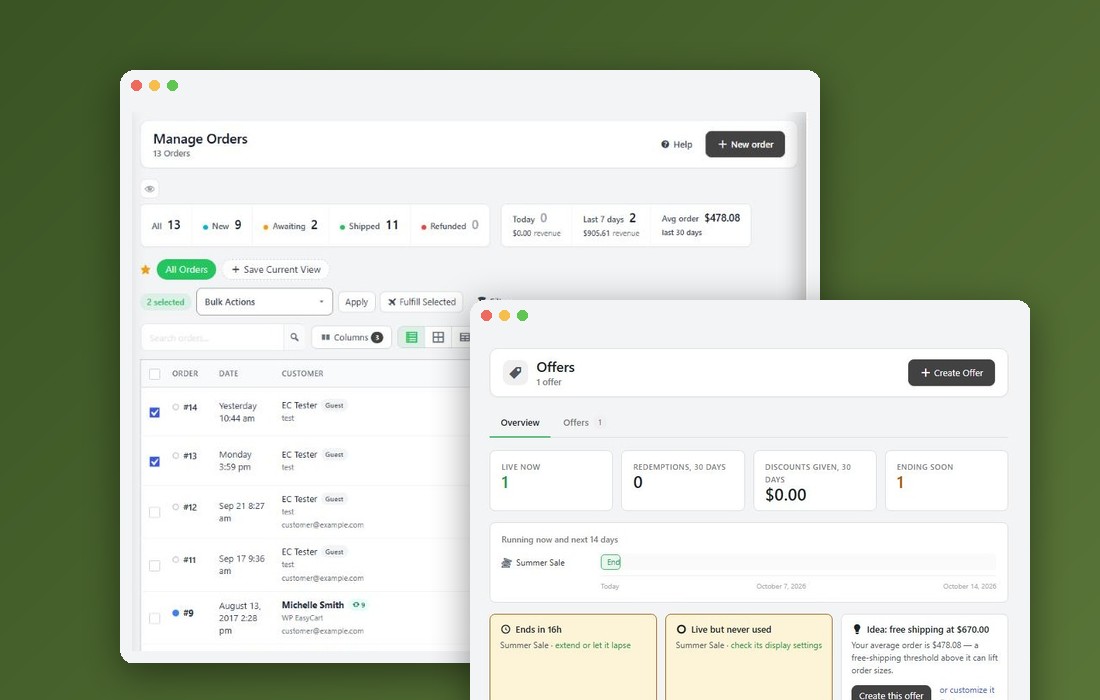
How do you charge tax?
One way for the whole store: built-in rates, a tax service, or no tax
no stored settingsThe line at the top says what checkout charges now, such as No tax is charged at checkout or the states and rates you collect in. Run the setup wizard, beside the title, starts the store setup wizard, whose first step asks your country and tax choices.
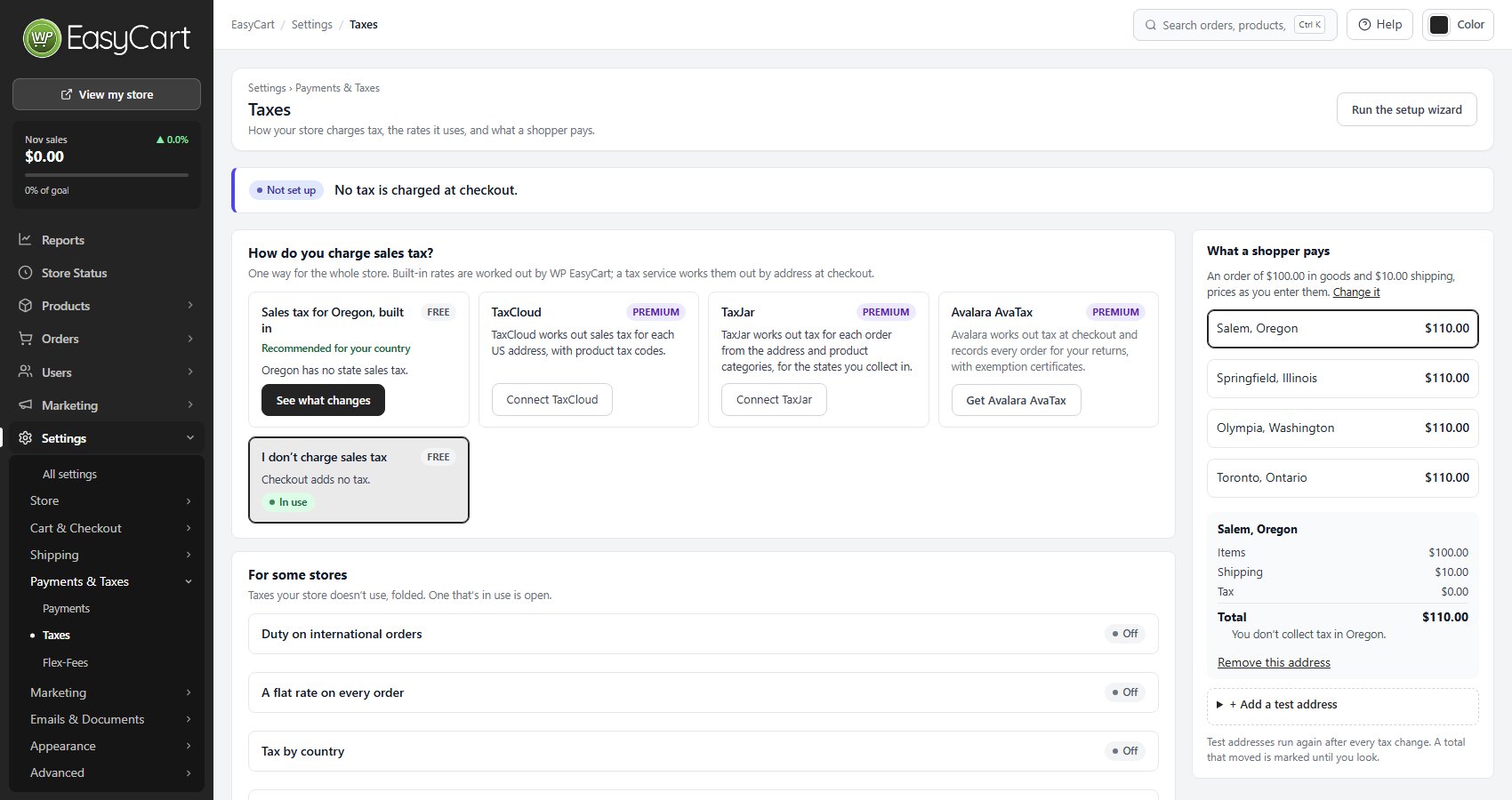
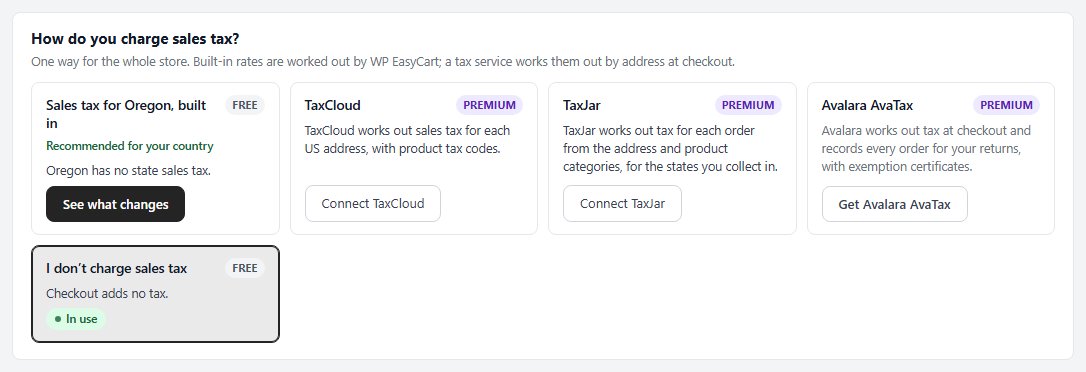
The first card asks one question, worded for your country: How do you charge sales tax? for a US store, How do you charge GST, HST and PST? for a Canadian one, and VAT or GST elsewhere. One way for the whole store: built-in rates are worked out by WP EasyCart, a tax service works them out by address at checkout. The way in use says In use.
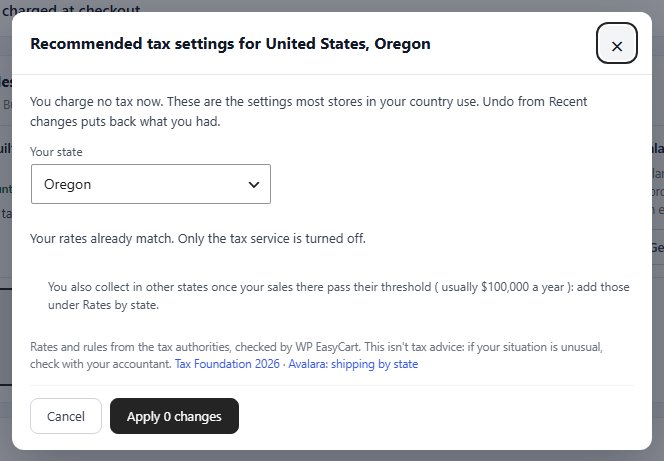
Built in ( free ): the settings most stores in your country use, such as Sales tax for Oregon, built in, marked Recommended for your country. See what changes opens Recommended tax settings for your country: the choices it needs ( a US store picks Your state ), the list of what would change, notes and sources, and Apply with the number of changes. TaxCloud and TaxJar ( PRO, US stores ): Connect opens the service’s settings. Avalara AvaTax ( a Premium extension, US and Canada ). I don’t charge sales tax ( free, worded for your country, such as Small supplier, not registered in Canada ): checkout adds no tax; your tax rates are taken off after you confirm.
Settings that differ from the recommendation show as Your own rates and are kept: they are only replaced if you apply the recommendation. Every change here is listed under Recent changes with Undo.
Under the card, Steps for the way in use lists what is left: other states once your sales there pass their threshold, reduced and zero VAT rates and business customers’ VAT numbers, or a service’s API details, ship-from address and product tax codes.
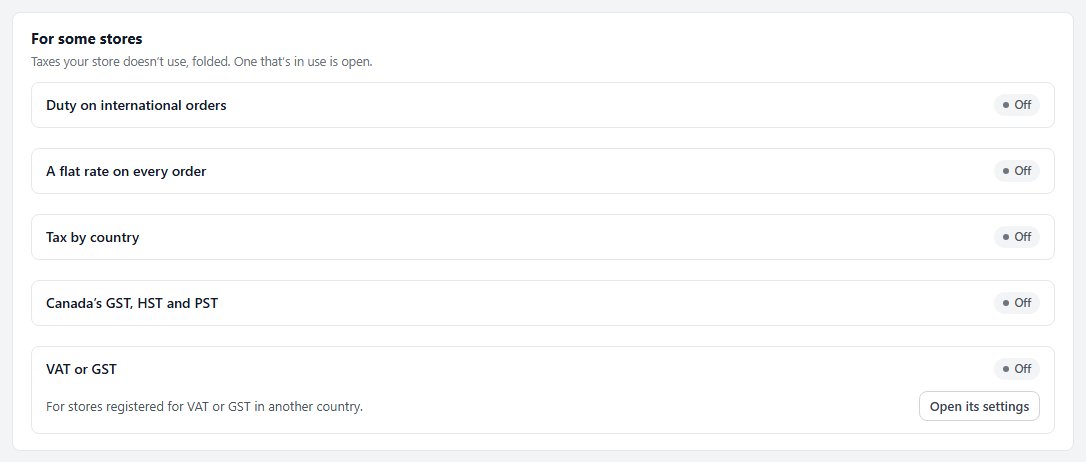
For some stores
Taxes your store does not use, folded
no stored settingsTaxes your store does not use sit folded here, each with a line on who needs it and Open its settings; one that is in use is open and says so. Duty on international orders: a percentage added to orders shipped abroad, for stores that collect import duty themselves. A flat rate on every order: one rate on every order wherever it ships, on top of any other tax, so most stores leave it off. Tax by country, Canada’s GST, HST and PST, VAT or GST and, for stores outside the US, US sales tax by state, for the stores that must collect them.
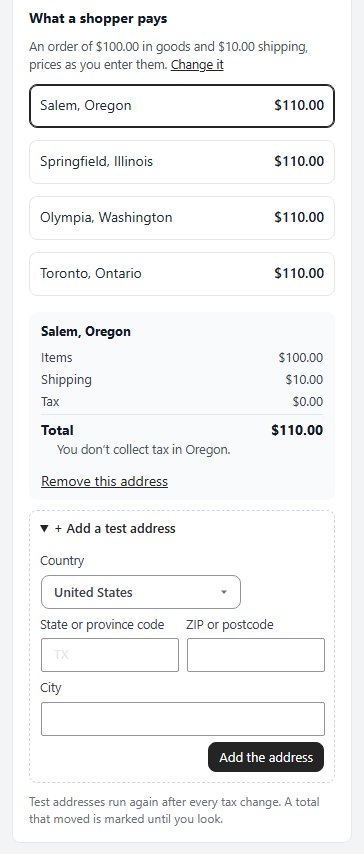
What a shopper pays
A sample order priced at test addresses you choose
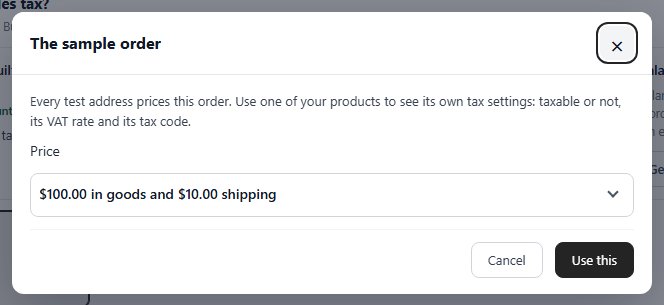
no stored settingsBeside the cards, What a shopper pays prices a sample order, $100.00 in goods and $10.00 shipping, the way checkout does, at four test addresses for your country. Pick one to see its items, shipping, each tax line with its rate and why, and the total. Change it sets the price of the sample, or uses one of your products so its own tax settings apply.
+ Add a test address takes a country, state or province code, ZIP or postcode and city ( and, for VAT, a business with a VAT number, taken as confirmed ); Remove this address takes one off. Up to 10 are kept. They run again after every tax change, and a total that moved is marked until you look.
While a tax service works out your tax, each address is asked of it only when you press Ask with its name, since each ask is one request to it. Asking TaxJar needs WP EasyCart PRO.
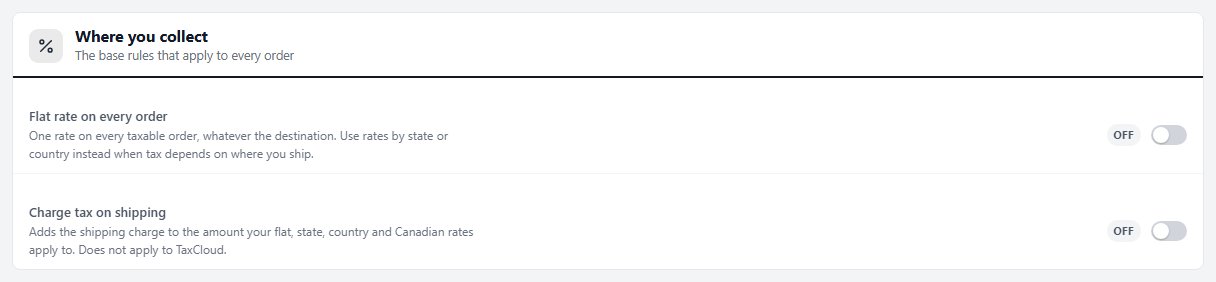
Where you collect
The base rules that apply to every order
2 settingsFlat rate on every order
Applies one rate to every taxable order regardless of where it is going. That is the right answer only when you genuinely charge the same everywhere, which usually means selling within a single jurisdiction. If tax depends on the destination, use rates by state or by country instead, because a flat rate will be wrong for most of your orders and wrong in a way nobody notices until filing.
Charge tax on shipping
Includes the shipping charge in the amount your flat, state, country and Canadian rates are calculated on. Whether shipping is taxable varies by jurisdiction and is not a matter of preference, so check rather than guess. It does not apply to TaxCloud, which makes that decision itself from the destination.
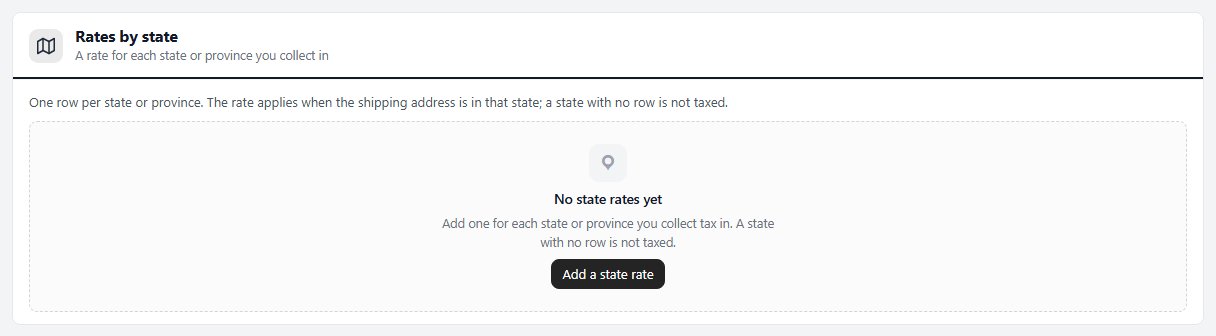
Rates by state
A rate for each state or province you collect in
no stored settingsNo stored settings here, just the rate table. Add a row for each state or province you collect in, with its rate. This is the right approach when you have a tax obligation in specific states rather than everywhere, which for most sellers is where they have physical presence or have crossed an economic threshold. Where the list would run to hundreds of local rates, an automated service is the more sustainable answer than maintaining this table by hand.
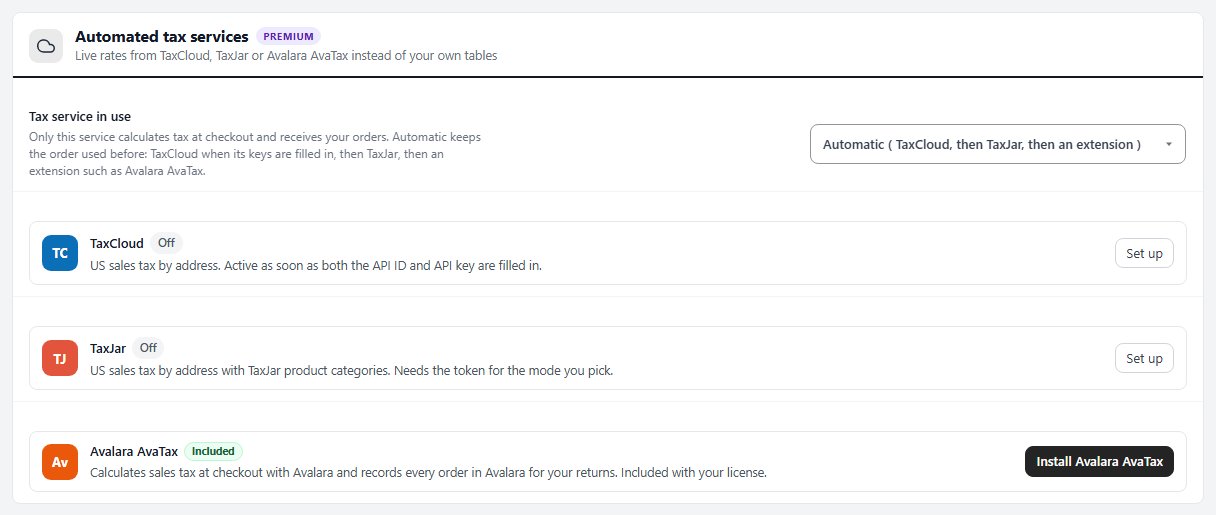
Automated tax services
Live rates from TaxCloud, TaxJar or Avalara AvaTax instead of your own tables
17 settingsTax service in use
Picks the one service that calculates tax at checkout and receives your orders: TaxCloud, TaxJar, an extension such as Avalara AvaTax, or None, which uses the rates on this page. Automatic keeps the order used before: TaxCloud when its keys are filled in, then TaxJar, then an extension. Naming the service is the safer choice once you have one, because a service that is set up but not chosen shows Not in use on its row and calculates nothing. Below the picker each service has its own row with its state, and Set up or Edit opens its settings in a drawer. AvaTax is an extension: its row opens its own settings under EasyCart › Extensions.
TaxCloud API ID
From your TaxCloud account. TaxCloud calculates United States sales tax live, by destination, which removes the job of maintaining thousands of local rates by hand. It is active as soon as both the API ID and the API key are filled in.
TaxCloud API key
The private half of the TaxCloud credentials. Only ever sent from your server, never to a shopper’s browser.
TaxCloud origin address
The street address you ship from. United States sales tax depends on origin as well as destination, so this is part of the calculation rather than a formality.
TaxCloud origin city
The city you ship from, used in the same origin calculation.
TaxCloud origin state
The state you ship from. Getting this wrong produces rates that look plausible and are wrong, which is the worst kind of error in tax.
TaxCloud origin ZIP
The ZIP code you ship from. United States rates vary within a state, so the ZIP matters.
TaxJar
Calculates United States sales tax through TaxJar once a token is entered, as long as TaxJar is the tax service in use. The TaxJar drawer also carries Test connection: using the saved settings, it checks the token, lists where your TaxJar account collects tax, prices a sample sale at your origin address and says what the last checkout lookup did. Save your changes before running it.
Sandbox mode
Talks to the TaxJar sandbox using the sandbox token rather than the live service. Nothing calculated in sandbox mode is real. Turn it off before you sell, and check that you have, because a store quietly running on sandbox tax is collecting figures it cannot file.
TaxJar live token
From your TaxJar account, used while sandbox mode is off. This is the token that produces real rates.
TaxJar sandbox token
From your TaxJar account, used only while sandbox mode is on.
Verify US addresses with TaxJar
Verifies United States addresses through TaxJar before calculating, which improves accuracy because the rate depends on the precise address. It needs a TaxJar Professional plan and applies to United States addresses only.
TaxJar origin address
The street address you ship from, used as the origin for TaxJar calculations.
TaxJar origin city
The city you ship from.
TaxJar origin state
The two-letter state or province code you ship from.
TaxJar origin ZIP
The ZIP or postal code you ship from.
TaxJar origin country
The country you ship from. Only countries TaxJar supports are listed, so an absent country means TaxJar cannot serve that origin rather than that the field is broken.
VAT
Value added tax, one rate or a rate per country
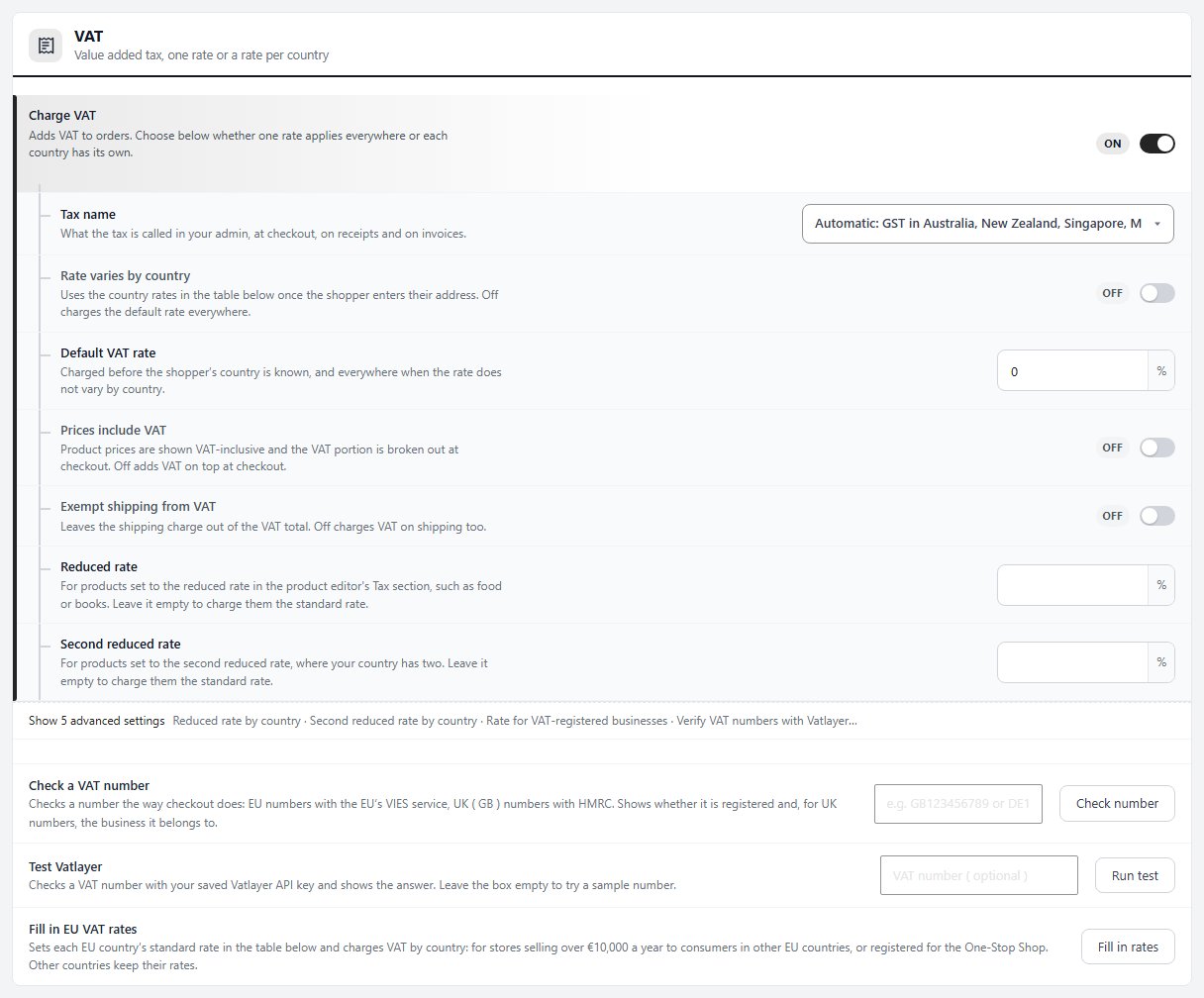
11 settingsCharge VAT
Turns on value added tax. VAT is not simply another tax rate: it changes how prices are quoted, how business customers are treated and what has to appear on an invoice. Switch it on only if you are actually VAT registered, and set the country rates below before taking orders.
Tax name
What the tax is called in your admin, at checkout, on receipts and on invoices. Automatic says GST for a store in Australia, New Zealand, Singapore, Malaysia or India, and VAT everywhere else; pick VAT or GST to choose it yourself. With GST, this section, the product editor’s Tax section and the wording shoppers see say GST where they said VAT. A store in Australia also gets its PRO invoice PDF titled Tax invoice, as long as the invoice title has not been changed.
Exempt shipping from VAT
Leaves the shipping charge out of the VAT calculation. Off charges VAT on shipping as well. In most VAT jurisdictions shipping follows the goods and is taxable, so leaving this off is usually correct, but the rule is national rather than universal.
Reduced rate
The rate for products whose VAT rate is set to Reduced rate in the product editor’s Tax section, such as food or books. Leave it empty and those products pay the standard rate. Products can also be set to the Zero rate, which needs no setting here. When an order mixes rates, receipts, invoices, the order confirmation and My Account show one VAT line per rate.
Country
A country’s own reduced rate, for customers there: press Add a country, type the two-letter country code and the rate ( for example DE 7, FR 5.5 ). A country listed here pays its own rate; every other country pays the reduced rate above. Use it when you charge each country’s own VAT, because reduced rates differ from country to country.
Second reduced rate
For products set to the second reduced rate, where your country has two. Leave it empty and those products pay the standard rate.
Country
A country’s own second reduced rate, entered the same way as the reduced rate by country, for customers in that country.
Rate for VAT-registered businesses
The rate charged instead of the country rate to a business abroad that enters a VAT number at checkout, unless its country is marked Apply to business. A business in your own country always pays your usual VAT. For a store in the EU, the number must belong to another EU country ( the delivery or billing country ) and check out in the EU’s VIES service, or with HMRC for a UK ( GB ) number. A number that cannot be checked because the service did not answer pays VAT. The order’s documents then say Reverse charge. A store outside the EU gives the rate to any business abroad with a number. It needs the VAT number field turned on under Checkout, and does nothing without it.
Verify VAT numbers with Vatlayer
An extra check with the Vatlayer service on the VAT number a shopper types at checkout. A number Vatlayer says is not valid stops the checkout until it is corrected or removed. The VIES and HMRC checks above run without it; turn this on only if you want Vatlayer as well.
Vatlayer API key
From your Vatlayer account. With no key, the Vatlayer check is skipped. Once it is saved, Test Vatlayer at the foot of this section checks a VAT number with the key and shows the answer; leave its box empty to try a sample number.
Rounding increment
The increment VAT totals round to. Most countries use 0.01, some require 0.05. This is a legal requirement rather than a display preference in the places that specify it, so check your own jurisdiction rather than leaving the default in place.
Ready to run your store on WP EasyCart?
Everything in this guide works with the free plugin. PRO and Premium add subscriptions, memberships, wholesale pricing and more. Try every PRO feature free for 14 days.