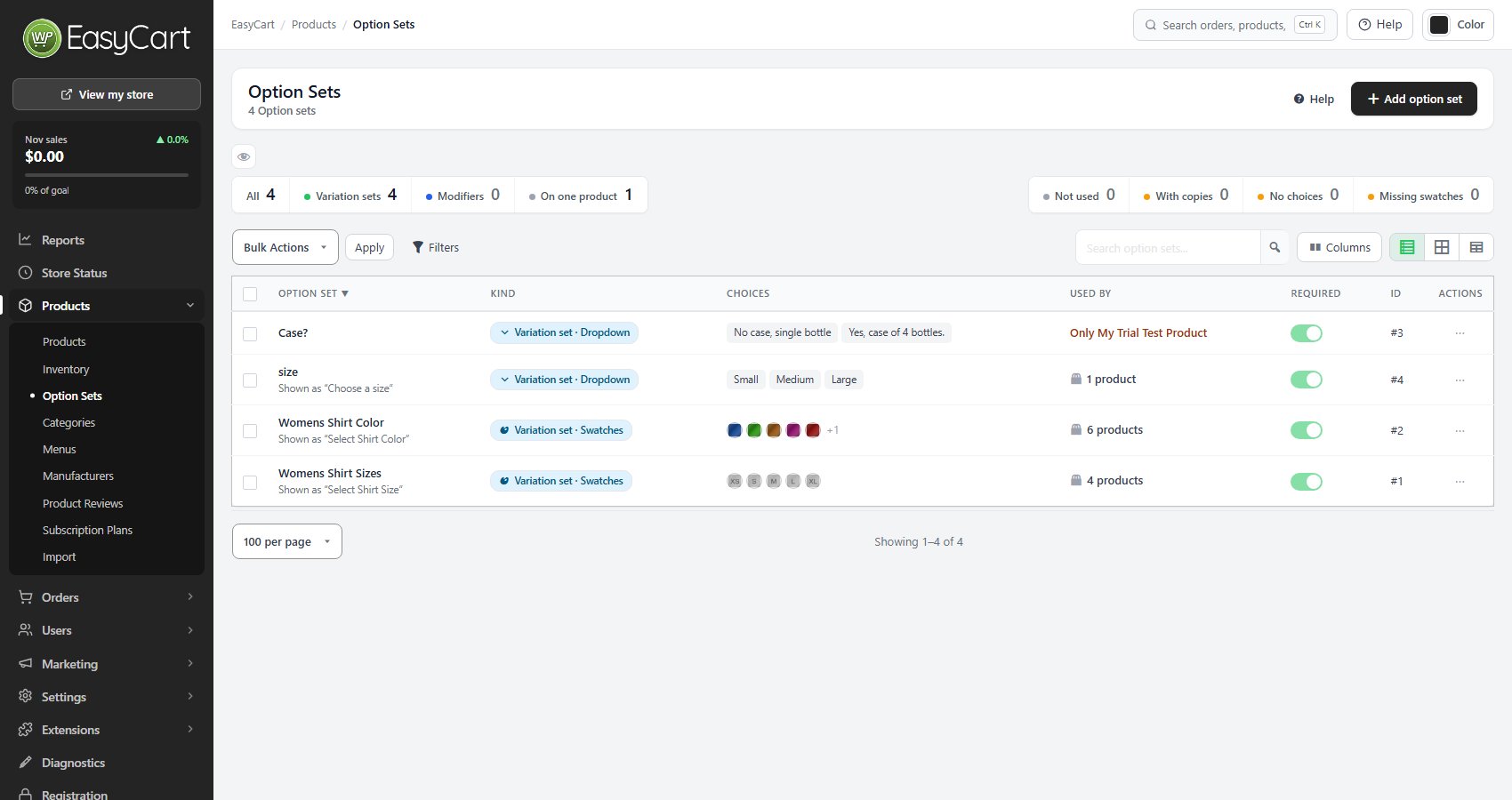
The option sets list
Every set, what kind it is, and who uses it
no stored settingsAn option set is a named group of choices, such as Size with small, medium and large. Make it once and add it to as many products as need it: twenty shirts share one Size set rather than each carrying its own copy.
The list shows each set with the label shoppers see, its Kind, its Choices, who it is Used by and whether it is Required. The kind says what the set does and how shoppers choose, such as Variation set · Dropdown or Modifier · Radio group. A set made for one product reads Only and that product’s name under Used by, and links to it.
Tiles count and filter the list: All, Variation sets, Modifiers and On one product on the left; Not used, With copies, No choices and Missing swatches on the right, for the sets worth a look. Bulk Actions set several required or optional at once, or delete them.
Each row’s menu has Edit option set, View products, Add to products…, Duplicate and Delete. Two more appear only where they apply: Let other products use it on a set made for one product, and Merge copies… on a modifier that has copies.
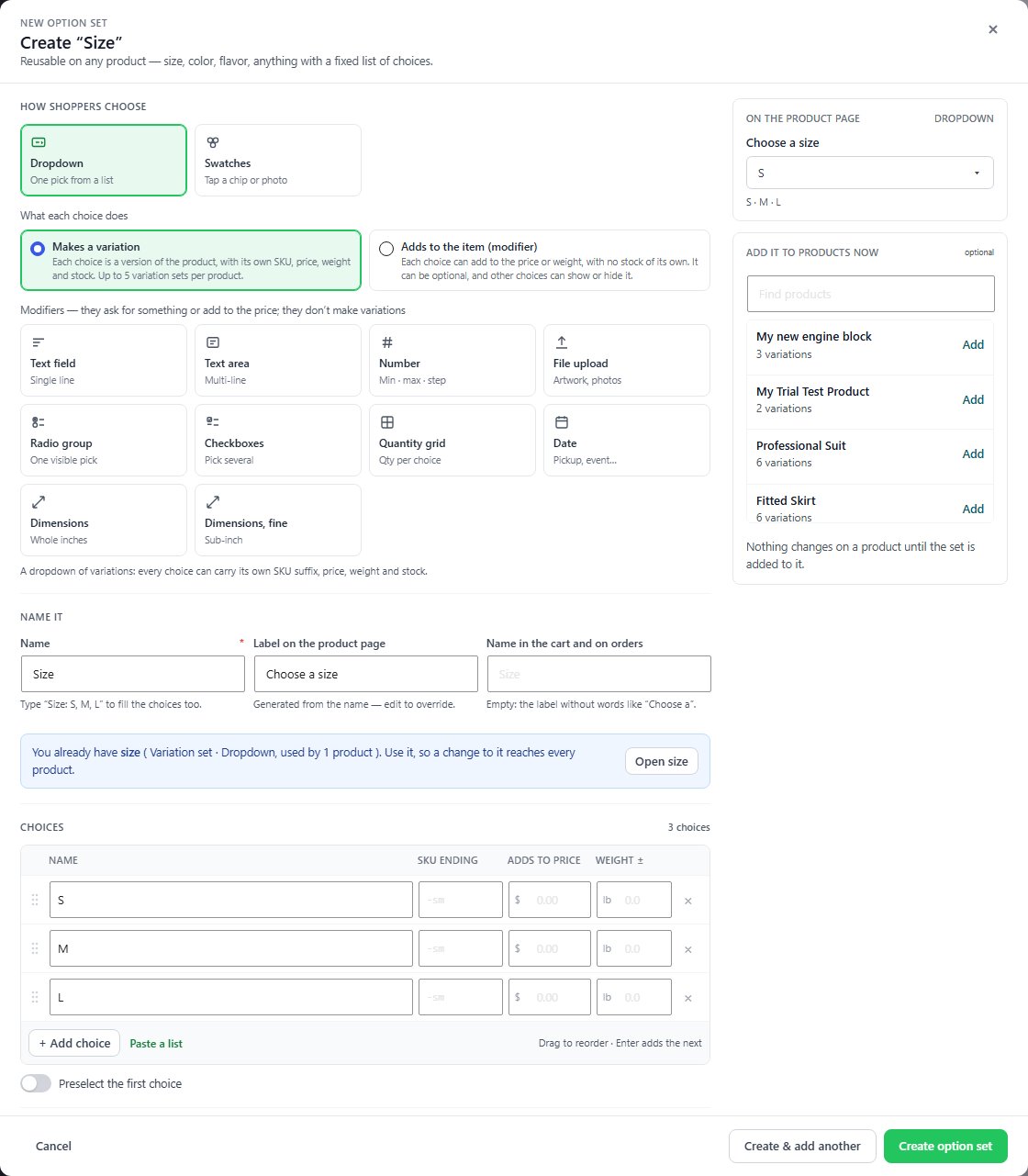
Making a set in the option builder
Add option set: how shoppers choose, a name, the choices and a preview
no stored settingsAdd option set opens the option builder. The same window opens wherever a set is added, on this list and in the product editor, so a set is made the same way everywhere.
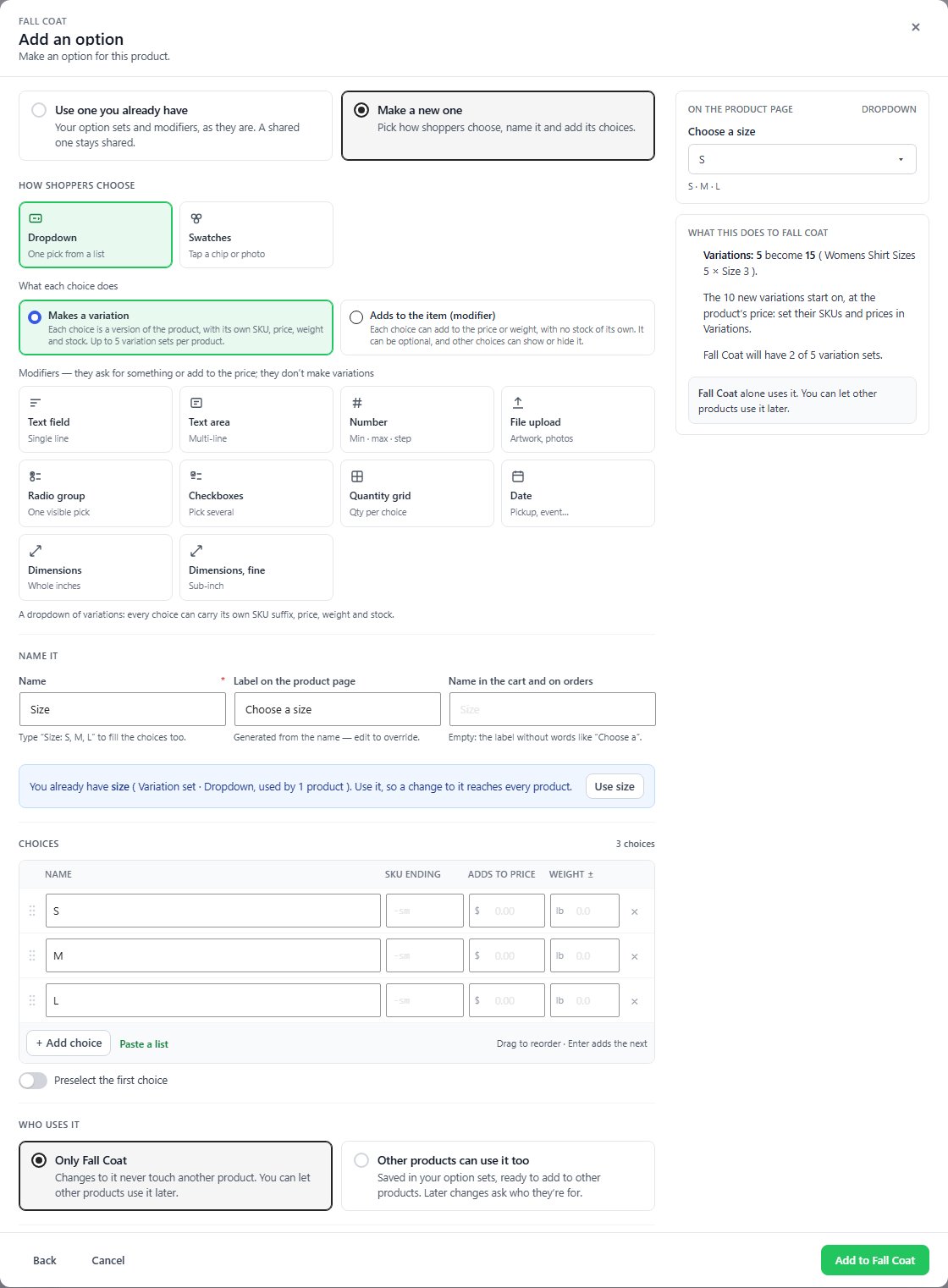
How shoppers choose comes first: Dropdown or Swatches, or one of the modifiers that ask for something: Text field, Text area, Number, File upload, Radio group, Checkboxes, Quantity grid, Date, Dimensions or Dimensions, fine. For a dropdown or swatches, What each choice does decides the rest. Makes a variation makes each choice a version of the product with its own SKU, price, weight and stock. Adds to the item (modifier) lets each choice add to the price or weight with no stock of its own; it can be optional, and other choices can show or hide it.
Then Name it. Type Size: S, M, L in Name and the window fills the choices too. The Label on the product page is made from the name, such as Choose a size, until you type your own, and Name in the cart and on orders left empty is the label without words like Choose a. If you already have a set of that name and kind, the window says so and offers it: using it means one change later reaches every product.
Choices takes a name, a SKU ending, what it Adds to price and its weight for each. Drag to reorder; Enter adds the next. Paste a list takes one choice per line, and +2.00 after a name sets its price. Preselect the first choice picks it for the shopper. On the product page, beside the form, shows the set as shoppers will see it as you type.
From this list the window also offers Add it to products now: find products and add the set to them as it is created. Nothing changes on a product until the set is added to it. Create option set makes it; Create & add another clears the window for the next one.
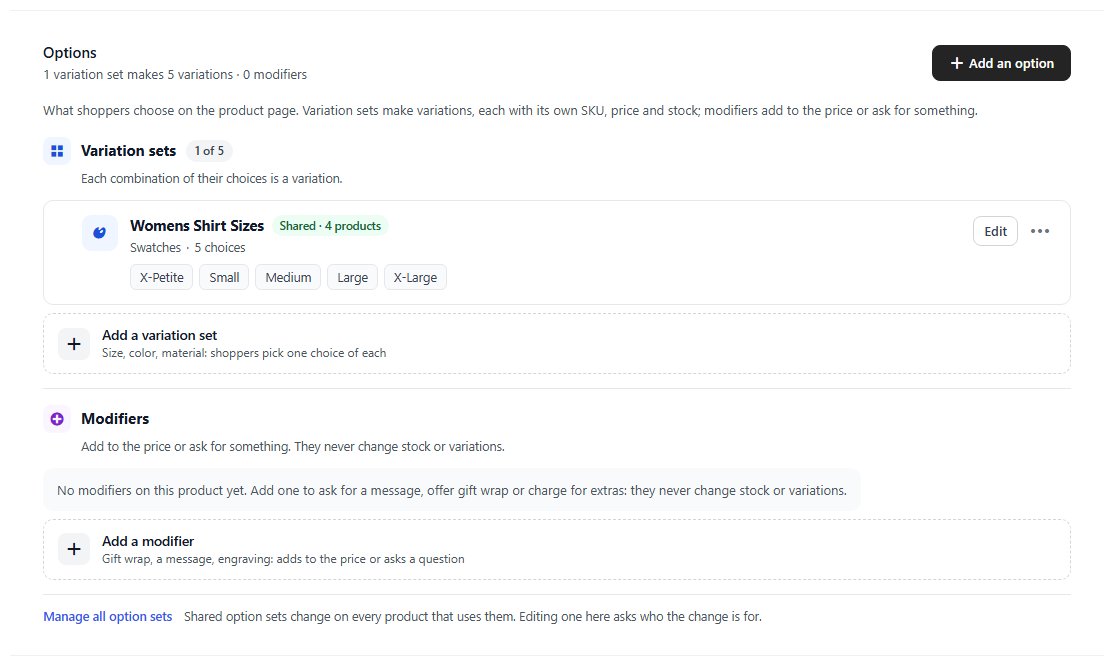
Adding an option to a product
Use one you already have, or make one for this product
no stored settingsIn the product editor, the Options card lists the product’s Variation sets and then its Modifiers, each with its choices and who uses it, such as Shared · 4 products. Add an option, Add a variation set and Add a modifier open the option builder for that product. Without PRO the editor’s Option sets section holds two sets.
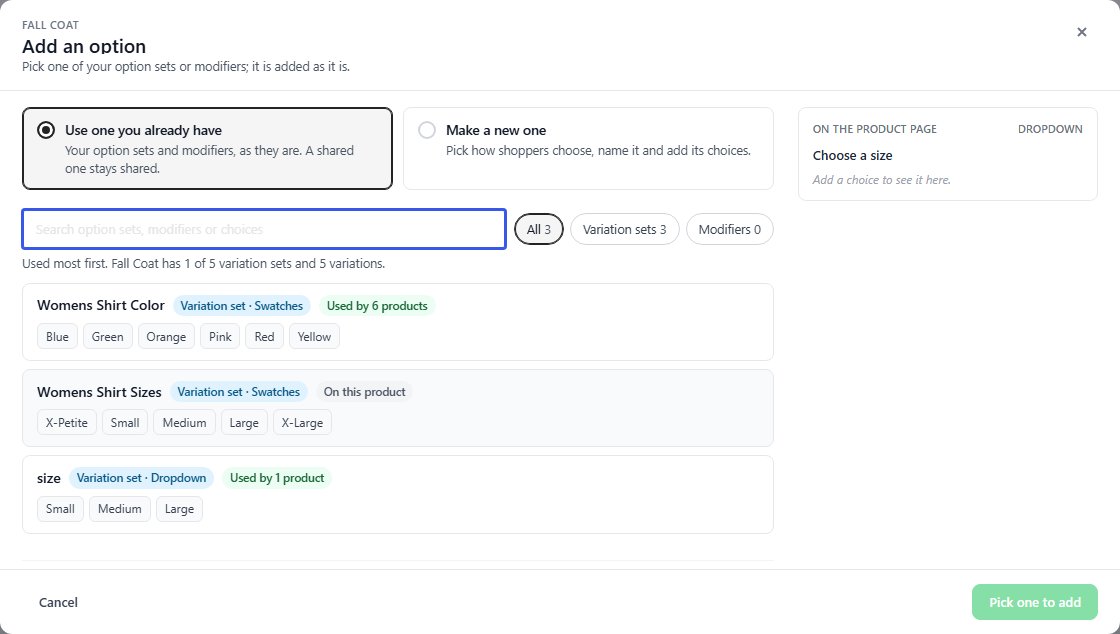
Use one you already have lists your option sets and modifiers, the most used first, with their choices. Search by name or choice, or show only variation sets or modifiers. A set already on the product says On this product. Pick one and Add puts it on the product as it is: a shared set stays shared.
Make a new one is the builder above, plus two things. What this does to the product says what will happen before you add it, such as 5 variations becoming 15, and that the new variations start on at the product’s price or with no stock, ready to set in Variations. A modifier never changes stock or variations. Who uses it asks who the set is for: Only this product, where changes never touch another product, or Other products can use it too, which saves it to your option sets as well.
A product can have up to five variation sets with PRO, two without. When it has five, the builder offers a modifier instead.
Changing a shared set, and copies
Every product or only this one, sharing a product’s own set, and merging copies
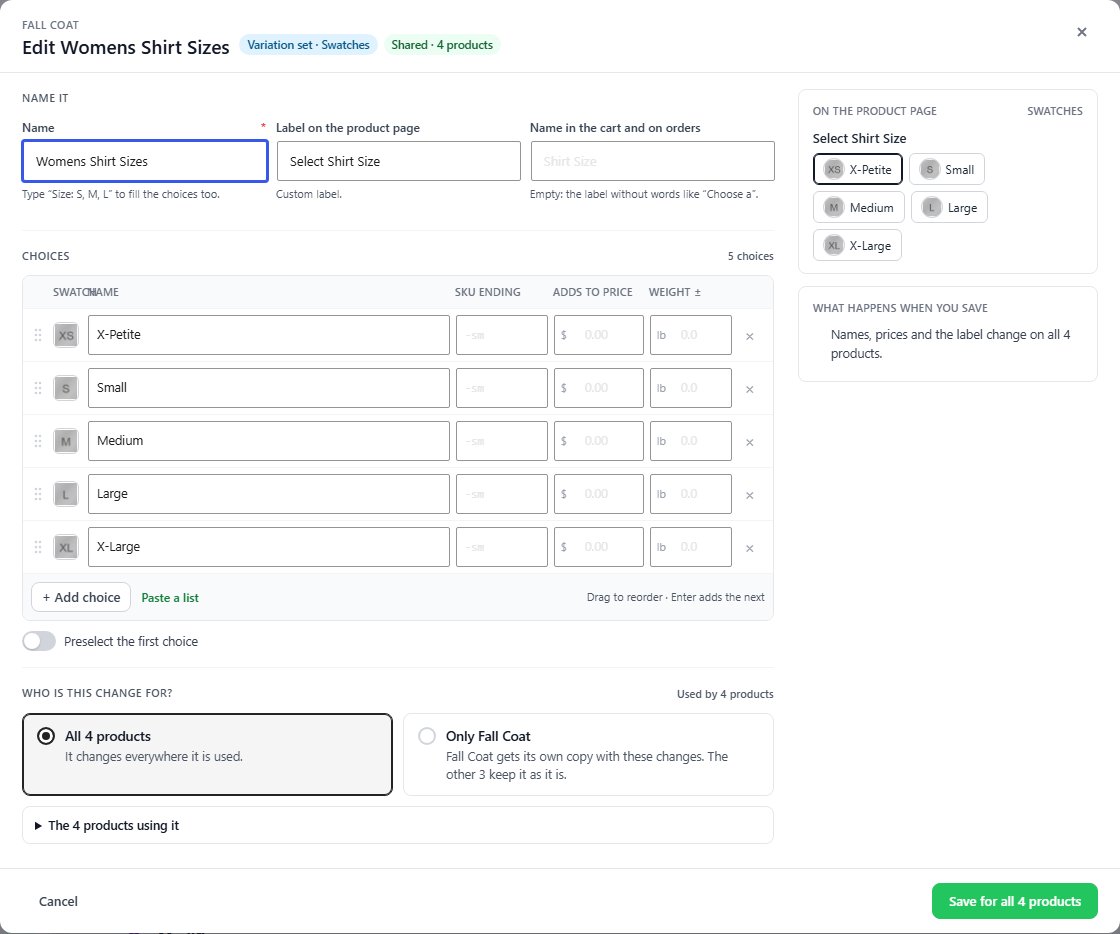
no stored settingsEdit on a set in a product’s Options card opens it in the option builder. When other products use it too, Who is this change for? asks before you save: All of the products, so the set changes everywhere it is used, or Only this product, which gets its own copy with your changes while the others keep the set as it is. The button says which, such as Save for all 4 products. Before you save, the window lists what the change does: choices added become new variations with no stock, and a choice removed takes its variations, with their SKUs and stock. Past orders keep the name.
A set made for one product can be shared later. Let other products use it, in its row menu or at the top of its editor, saves it to your option sets so every product can use it.
Copies happen: a modifier made on several products, each its own, with the same name. The With copies tile and a note above the list find them, with Review copies. Merge copies… in the modifier’s row menu lists the products whose copy matches and those Left as they are, with the reason. Merged, they all use the one saved set, so a change reaches every one of them. Each product keeps where the modifier shows, who sees it and its rules; carts and past orders keep what was chosen, and Recent changes lists each product with Undo.
The option set page
Name it, Choices, Who uses it, and how choices multiply into variations
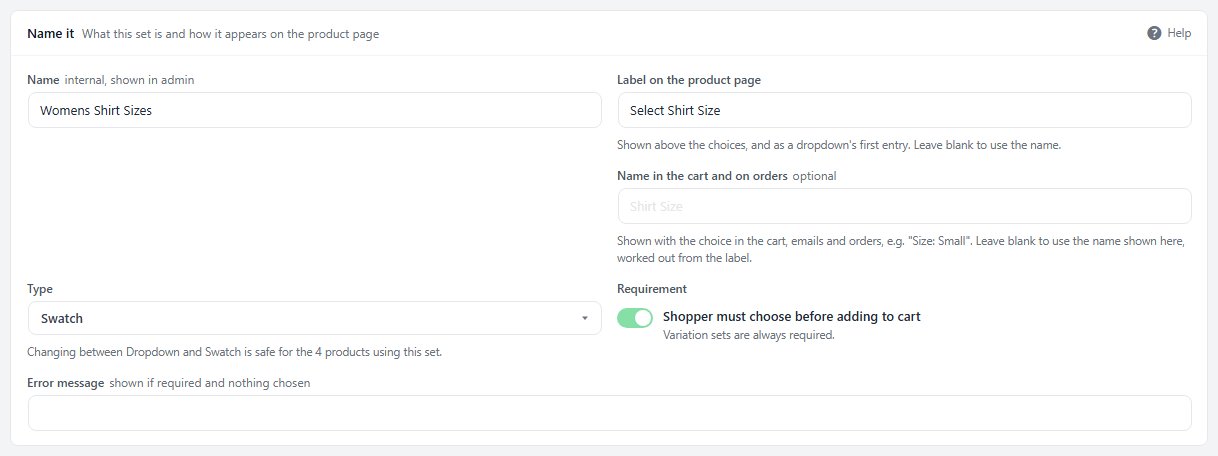
no stored settingsClick a set on the list to open its own page. The header says its kind, how many choices it has and how many products use it. Name it holds the internal Name, the Label on the product page, the Name in the cart and on orders, the Type and whether the shopper must choose before adding to cart; variation sets are always required.
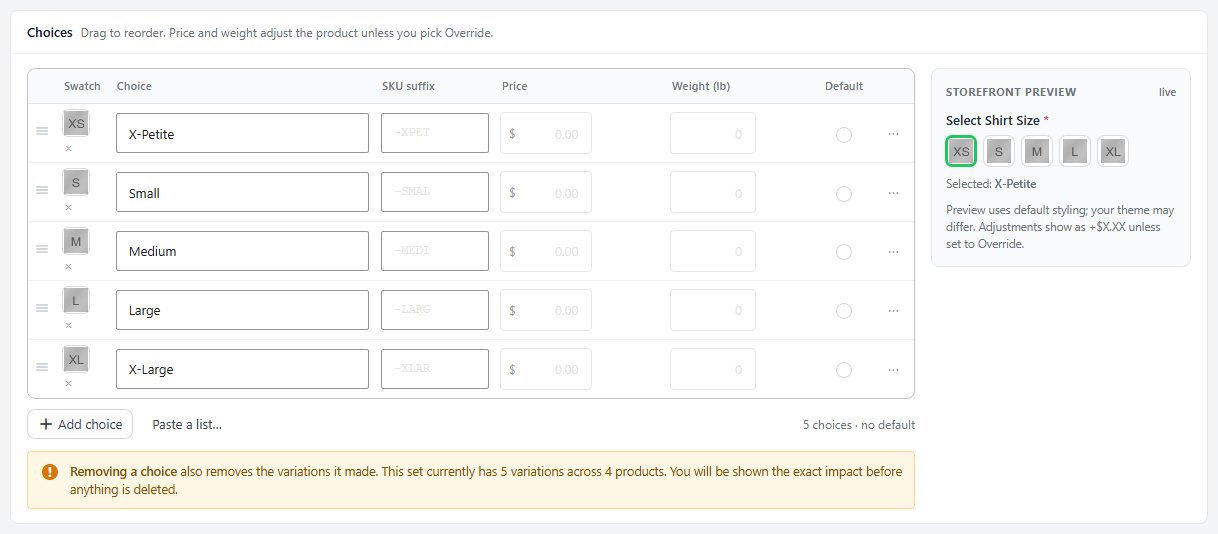
The label is the prompt shoppers read above the choices, and a drop-down’s first entry, such as Select Shirt Size. The name in the cart and on orders is what the cart, checkout, order emails, invoices and the order itself print beside the choice, such as Size: Small. Leave it blank and the name is worked out from the label: a leading Select, Choose or Please select and a trailing colon come off, so Select Shirt Size becomes Shirt Size, and the field shows that name in grey. Orders placed before the name existed keep what they recorded, with the prompt taken off when they print.
Choices lists each choice with its swatch, a SKU suffix, a price and a weight, which adjust the product unless you pick Override, and which one is the default. Drag to reorder, or Paste a list… with one choice per line. A Storefront preview beside it shows the set as shoppers will see it.
Where a product has more than one variation set the choices multiply: three sizes and three colors make nine variations, each with its own stock and SKU. Removing a choice also removes the variations it made, and you are shown the exact effect before anything is deleted.
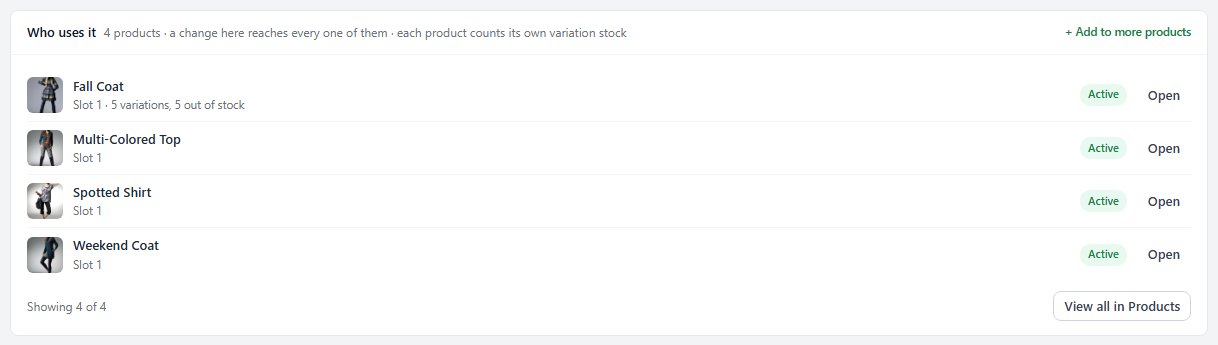
Who uses it lists every product with the set and how many variations each has, and + Add to more products adds it to others. A change here reaches every one of them. The Set health list flags gaps such as no default choice or choices missing a SKU suffix. Danger zone deletes the set after showing what is affected, and offers to replace it instead.
Modifiers and their rules
Inputs that collect something rather than pick a variation
no stored settingsModifiers ( PRO ) collect something from the shopper and travel with the order. They can add a price but never change stock, and they do not create variations. Without PRO a modifier is shown read-only.
Rules & validation shows only the rules for the set’s type. Text fields and areas take a length, a Text case ( as typed, UPPERCASE, lowercase or Title Case ), Allowed characters ( letters, numbers, spaces and mixes ) and a Placeholder. The rules apply as the shopper types and again when the item is added to the cart, so pasted text cannot slip past them.
File uploads take a list of Accepted file types; scripts, web pages and SVG files are always refused. Numbers and dimensions take a minimum, maximum and step, and a quantity grid takes row and column limits. Every type has a URL variable that pre-selects a choice from a link.
Swatches take a Swatch size: Small (20px), Medium (30px), Large (40px), Extra large (60px), or 80px up to 200px in steps of 20, large enough for photo swatches of fabrics or prints. Photo swatches are PRO.
On a product, a modifier’s rules can show it only for some choices, such as when Size is Large. On the product page, the choices of a radio group or checkboxes show as cards the shopper can click anywhere on, with the price on the right and the choice made marked in your store’s main color.

Ready to run your store on WP EasyCart?
Everything in this guide works with the free plugin. PRO and Premium add subscriptions, memberships, wholesale pricing and more. Try every PRO feature free for 14 days.