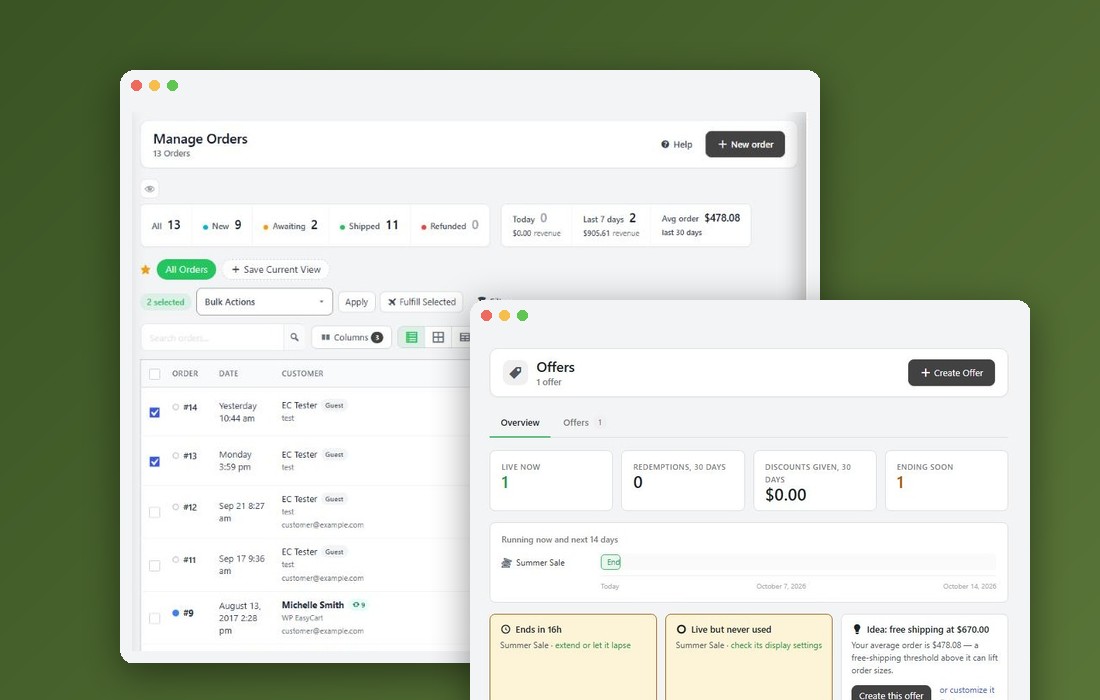
Settings › Shipping › FedEx
Live FedEx Shipping Rates
Create a FedEx developer project, enter its keys, choose the FedEx services you offer and let shoppers pick from live FedEx prices at checkout. 13 parts.
Quick links
Where to find it:WP Admin › EasyCart › Settings › Shipping › Carriers & labels › FedEx
Before you start
How it works
What live FedEx rates do, what they do not, and what you need.
How live FedEx rates work
What they do, what they do not, and what you need
What you need. WP EasyCart PRO or Premium (live carrier rates are a PRO feature), a FedEx account, and a free FedEx developer project to get the keys WP EasyCart signs in with.
What live rates do. At checkout WP EasyCart sends FedEx the contents of the cart, the shopper’s address and your ship-from address, and shows the services and prices FedEx returns. It works from each product’s weight and package size, so every shippable product needs both.
What they do not do. Live rates only quote. They do not book a pickup or buy a label. To buy and print FedEx labels from the order screen, use the Shippo or ShipStation extension. A discount you get through one of those services is not passed into the live quote; live quotes use your own FedEx account.
The steps are: create the FedEx project, enter its keys and your account number, switch the store to live rates, choose the FedEx services you want to offer, and make sure your products have a weight and size.
Connect FedEx
Keys and account
Create the FedEx project, enter its details and check it says Connected.
Step 1. Create a FedEx developer project
Test keys first, then production keys
FedEx gives out its connection keys through its developer portal. The screens are FedEx’s and change from time to time, so follow FedEx’s prompts if a label differs.
1. Go to developer.fedex.com and sign in, or create an account.
2. Open My Projects and create a new project. Choose that you are a third-party software solution requesting API keys.
3. Pick Ship, Rate & Other APIs.
4. Tick the Rates and Transit Times API and the Address Validation API.
5. Name the project, choose your country of origin, confirm the details and accept both the terms and the integration options.
FedEx then shows test keys. Use these first, with Test mode on. When you are ready for real quotes, open the project’s Production Key tab, give the key a name, choose the FedEx account to use and create it. Your production account number is different from the one on your test project.
💡 Note: Test keys and production keys are separate and come with different account numbers. Keep Test mode on while you use test keys and turn it off when you move to production keys.
Step 2. Enter your FedEx details
Two keys, an account number and your ship-from details
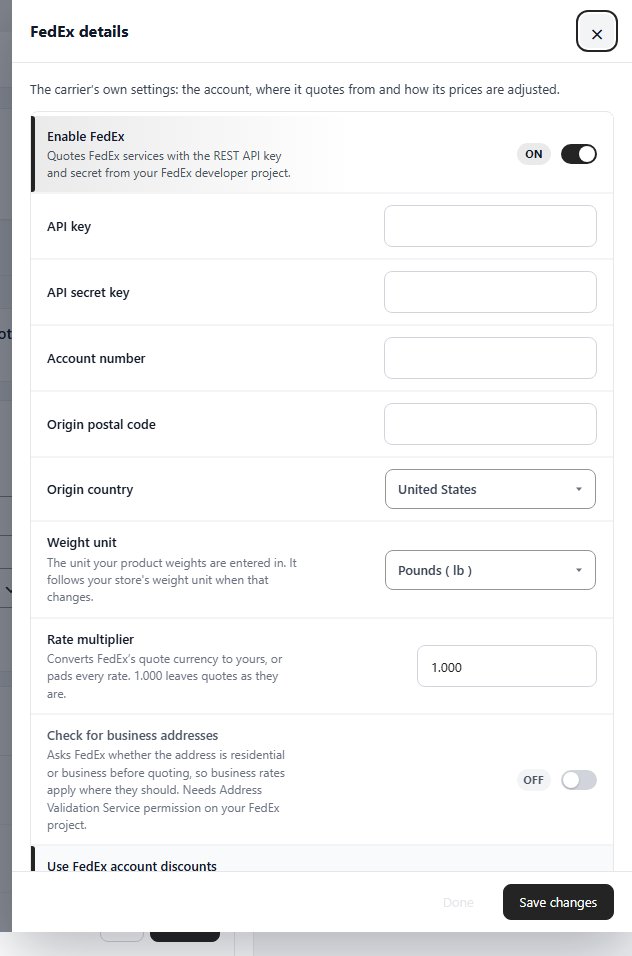
Open EasyCart › Settings › Shipping › Carriers & labels. Under Carrier accounts, press Connect on the FedEx row. The FedEx details drawer opens. Turn Enable FedEx on, then fill in:
API key and API secret key: from your FedEx project. Paste them in carefully; a space before or after is the most common reason FedEx refuses them. The secret is hidden as you type.
Account number: your FedEx account number. Use the one that matches the keys: test or production.
Origin postal code and Origin country: where your parcels ship from. If you filled in Where do parcels leave from? at the top of Carriers & labels, they are already there.
Weight unit: pounds or kilograms. It follows your store’s weight unit when that changes; a store that weighs in ounces uses pounds here, one in grams uses kilograms.
Press Save changes. The first time you save, WP EasyCart adds the usual FedEx services to your live rates for you.
Check the connection
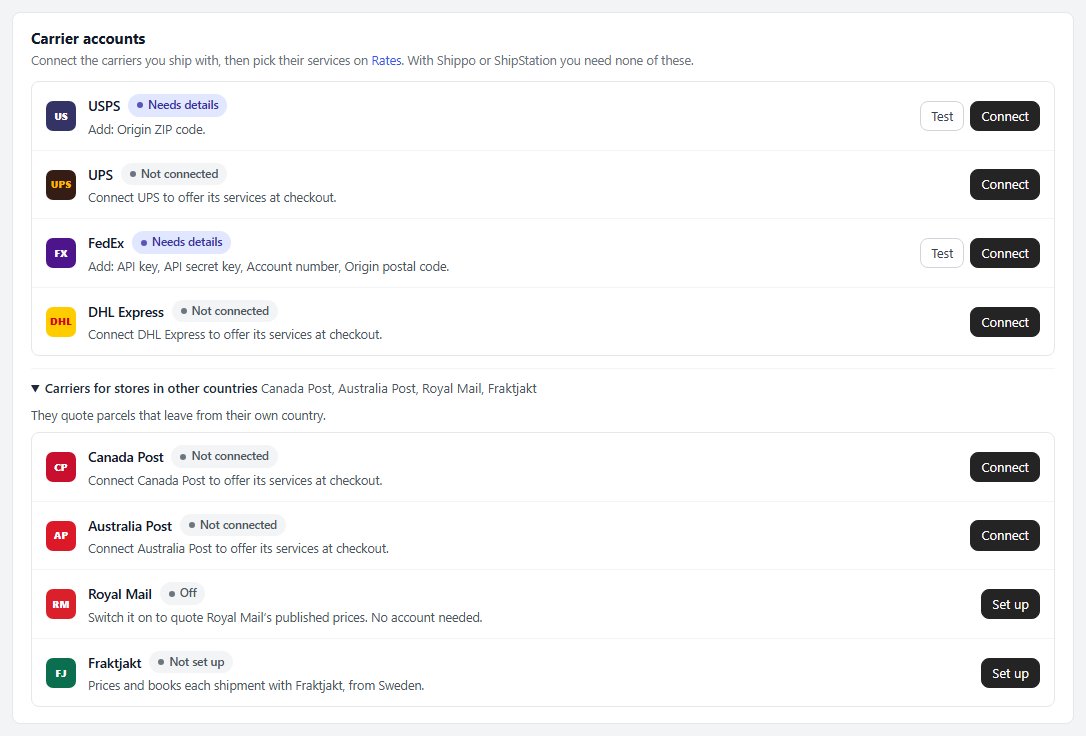
Connected, Needs details, Not connecting or Not connected
The chip on the FedEx row in Carrier accounts tells you where you are:
Connected: FedEx accepted the keys and WP EasyCart can get rates.
Needs details: something is still empty. It says what, for example Add: API key, API secret key, Account number, Origin postal code.
Not connecting: FedEx did not answer, or turned the details down. It then says FedEx did not accept these details and tells you to check the credentials, account number and origin address, and whether test mode matches your account.
Not connected: Enable FedEx is off.
Test on the row asks FedEx now, the way checkout asks; Connection checks, beside the cards, asks every carrier with Check every carrier now.
Test mode and the other FedEx settings
Sandbox, discounts, business addresses and a rate multiplier
Further down the FedEx details drawer:
Test mode: sends requests to FedEx’s sandbox, for the test keys. Turn it off when you switch to production keys.
Rate multiplier: 1.000 leaves FedEx’s quote as it is. Enter 1.100 to add 10% to every FedEx rate, or use it to convert FedEx’s currency to yours.
Check for business addresses: asks FedEx whether the address is residential or business before quoting, so business rates apply where they should. Needs the Address Validation permission on your FedEx project, which is why step 1 ticks that API. Off by default.
Use FedEx account discounts: quotes your negotiated FedEx rates instead of list rates. On by default.
Turn FedEx on or off
One switch, and nothing is lost
Turn Enable FedEx off and FedEx stops quoting at once; its row reads Not connected. Your keys, account number and ship-from details are kept, so turning it back on brings FedEx straight back.
Use this to pause FedEx without losing your setup, for example while you test another carrier.
Show FedEx rates
Choose live rates and services
Make live rates the way shoppers pay, switch on the services and get your products ready.
Step 3. Make live rates the way shoppers pay
FedEx does nothing until it is
Open EasyCart › Settings › Shipping › Shipping. Under How do shoppers pay for shipping?, press Use this on Live rates. The card then says In use.
The card under it becomes Where do live prices come from?: FedEx shows Connected and how many of its services checkout offers, with Pick services. The rates you built for your own rates are kept, but not used while live rates are in use.
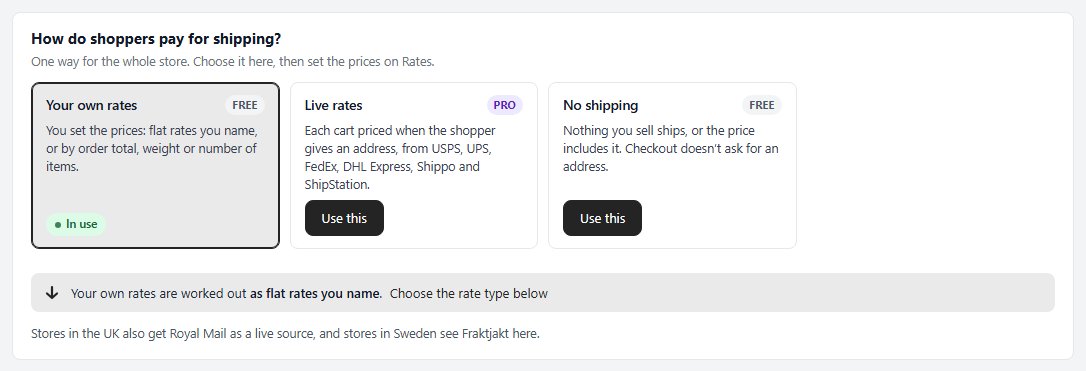
⚠️ Careful: Changing the way shoppers pay changes what every shopper is charged. Rates you built for your own rates are kept, but not used.
Step 4. Choose the FedEx services shoppers see
A switch for each service, in each shipping zone
Open Settings › Shipping › Rates ( or press Pick services ). The Everywhere else block lists your carriers, each with Connected or Not connected. Under FedEx, each service has a switch: on means checkout offers it. The first time you save FedEx details, WP EasyCart switches on the usual FedEx services if none are listed yet: Ground ( Home Delivery ), 2 Day, Priority Overnight, International Economy, International First and International Priority. The rest fold under More FedEx services with how many there are.
A shipping zone with prices of its own has its own block, so you can offer different FedEx services to one region. Which prices a shopper in a zone sees is chosen at the top of Rates.
Offer three or four services that are clearly different in speed and price. A long list with similar names makes shoppers pick the cheapest or leave.
Prices, free shipping and names
FedEx’s price or yours, and free over an amount
A service that is on shows its price. FedEx’s price charges what FedEx quotes. Fixed price charges the amount you type instead, which is how you absorb part of the cost or round a rate to something friendlier. Free over makes the service free once the order reaches that amount; empty reads Never free. This targets one service, so you can offer free FedEx Ground over a set order value while the faster services still cost.
To change the name a service shows at checkout, press Every rate table under All settings at the foot of Rates. The older editor opens: Edit on a FedEx row has Shown to shoppers as.
Step 5. Get your products ready
A weight and a size, and Ships to the customer on
Live rates quote each cart from its products, so edit every product you ship. Open the product, go to its Shipping section, and set:
Ships to the customer: on, or the item is left out of the shipping calculation.
Weight, Width, Height and Length under Package: the package details live rates use.
On Shipping, Weights and sizes says whether every product that ships has a weight, and Products without a weight count as sets what one without counts as. Enter weights and sizes in your store’s units, set in Settings › Store details; each carrier is sent them in the units it reads.
Delivery days and other live-rate options
How quotes are shown
While shoppers pay live rates, the Shipping page adds these for every carrier:
Show estimated delivery days, under At checkout: adds FedEx’s transit estimate beside each rate, where FedEx gives one. On by default.
Quote each item as its own parcel, under Fine-tune: asks for a rate per item and adds them up, instead of one combined package. Only for goods that cannot ship together; it usually costs more.
Always show overridden rates, under Fine-tune: a service you gave a fixed price is shown even when FedEx returns no rate for the address.
Keep it working
Test and troubleshoot
Check real addresses, and what to look at when a rate is missing.
Test it before you announce it
Try the addresses your customers really have
On Shipping, Test a cart asks FedEx for any cart and address the way checkout does. Describe a cart or pick products, enter the country, state and postcode, and press Ask for live rates. Every service offered comes back with how its price was worked out: what FedEx quoted, your fixed price, free over an amount, your handling fee. A service FedEx gave no price for is listed with the reason. Save the cart to run it again after every change.
Try a city near you, a rural address, another state and, if you ship abroad, another country. Expect the list to change: a given address may get only some of your services, and some are international only. Make sure at least one rate appears for every place you ship to.
Every order records the service the customer chose and what they paid for it.
💡 Note: Asking for live rates is a real request to each carrier and rate service. Zones and handling fees are explained in Settings › Shipping › Shipping and Settings › Shipping › Rates.
When a FedEx rate does not show
The usual causes, in order
FedEx is not Connected. Fix that first on Carriers & labels. Check the keys for a stray space, that the account number matches the keys, and that Test mode matches: on for test keys, off for production keys.
Live rates are not the way shoppers pay. FedEx is only asked when they are. See step 3.
No FedEx service is switched on for that address. Check the Everywhere else block, and the block of any shipping zone the address is in. See step 4.
The product has no weight, or Ships to the customer is off. See step 5.
FedEx was skipped. If FedEx refuses a connection or fails, WP EasyCart skips FedEx for five minutes and writes FedEx Rates Paused to Settings › Advanced › Log entries. Saving the FedEx settings again lifts the pause at once.
Still stuck? Open a ticket at wpeasycart.com/my-account.
Keep going
Related panels
How shoppers pay for shipping, and a test cart.
The services each carrier offers, by shipping zone.
Product weight and package size.
Where a paused carrier is recorded.
Ready to run your store on WP EasyCart?
Everything in this guide works with the free plugin. PRO and Premium add subscriptions, memberships, wholesale pricing and more. Try every PRO feature free for 14 days.