
Admin panels › Marketing
Abandoned Carts
Carts that were filled and left, and the sequence of emails that tries to bring them back, with the timing rules that stop it becoming a nuisance. 4 parts.
Quick links
Where to find it:WP Admin › EasyCart › Marketing › Abandoned Cart
What was left behind
Carts and the sequence
The carts themselves, and the steps that chase them.
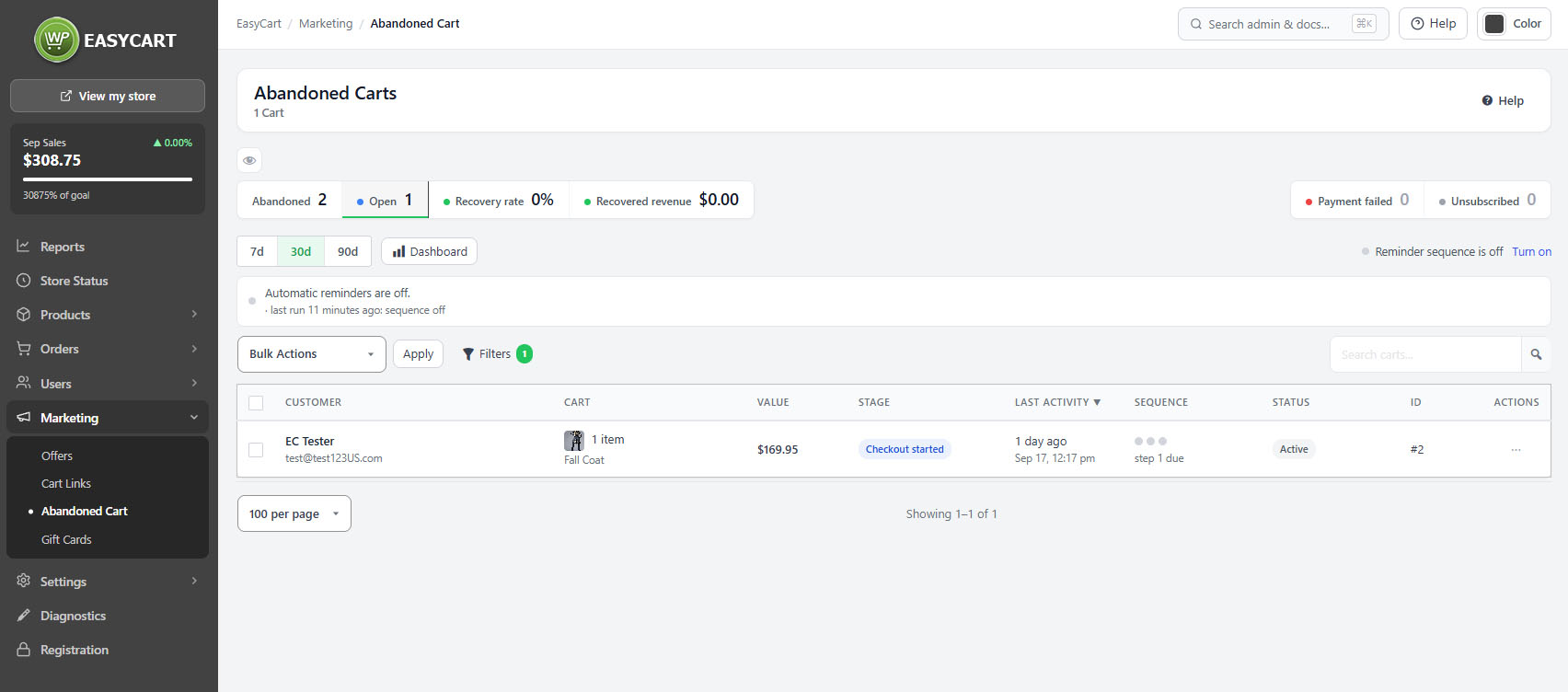
The abandoned carts
Carts that were filled and left, and what happened to them
no stored settingsA cart becomes abandoned once it has sat untouched for a period you set, and it stays in the list until it is either recovered or forgotten. The list is worth reading for its own sake before you send anything: patterns in what gets abandoned often point at a problem in the checkout rather than a failure of intent.
Carts abandoned after a payment failure are tracked separately, because they are a different problem with a different answer. Somebody whose card was declined wanted to buy and could not; that is a more valuable message to send, and a more urgent one.
Carts are eventually forgotten, after a period you also set. Forgotten carts are kept for reporting and marked expired, so your historical numbers stay intact while the customer stops being chased.
The recovery sequence
Several steps, each with its own delay and wording
no stored settingsRecovery is a sequence of steps rather than a single email. Each step has its own delay, subject, heading, intro text and button wording, so the tone can change as the sequence goes on: a helpful reminder first, something more persuasive later.
A step can carry a discount, with its own expiry. Discounting on the first message is usually a mistake, because you pay a margin to people who were going to return anyway. Holding the discount for a later step targets the ones who genuinely needed a push.
Every step can be sent to yourself as a test, which is the only sensible way to check wording and rendering before it reaches customers.
This is distinct from the single daily reminder configured on the Checkout panel. That one is the simple version; this is the full sequence.
💡 Note: The single daily reminder on Settings › Checkout is the simple alternative to this. Use one or the other rather than both.
Keeping it civil
Rules and privacy
The caps and windows that stop recovery becoming spam, and what is being captured.
Timing and rules
The guards that stop recovery becoming spam
no stored settingsSeveral limits work together, and they exist because recovery email is the easiest thing in a store to over-send.
How long before a cart counts as abandoned, measured in minutes of inactivity, and how long before it is forgotten bound the whole exercise. One sequence per customer every N days stops a regular shopper being chased constantly. A sending window keeps mail out of the middle of the night, using store time, with anything due waiting for the window to open. And a cap per fifteen minutes protects your sending reputation if a large batch comes due at once.
Taken together these turn a feature that can easily annoy people into one that mostly recovers sales.
💡 Note: The per-customer frequency cap and the sending window are what separate recovery from nuisance. Set both before switching the sequence on.
Tracking and privacy
When the address is captured, and what is measured
no stored settingsRecovery depends on having an email address before the order exists. The setting that saves the address as soon as it is typed at checkout is what makes most recovery possible, and it is also the one to think hardest about, because it captures an address from somebody who did not complete a purchase.
There is an explicit setting for selling in the EU or UK, which adjusts behaviour for those requirements. If you sell there, switch it on and take advice on your privacy notice; the feature gives you the control, it cannot make the legal judgement for you.
Open and click tracking are separate switches. Both are useful for knowing whether the sequence works, and both are personal data. Turning them off costs you measurement, not recovery.
⚠️ Careful: Saving the email as soon as it is typed captures an address from a shopper who never completed an order. That is what makes recovery work, and it is a decision to make deliberately. There is a dedicated setting for EU and UK selling; switch it on if that applies to you.
Keep going
Related panels
The simple daily reminder, and the checkout being abandoned.
Discount codes to attach to a recovery step.
Links that return a shopper to a filled cart.
Sender addresses and deliverability for these emails.
The abandoned cart figure, and what recovery is worth.
The marketing list, a different consent from this one.
Try the PRO features free for 14 days
Anything marked PRO comes with WP EasyCart PRO or Premium. Take the whole thing for a run on your own store before you decide.
